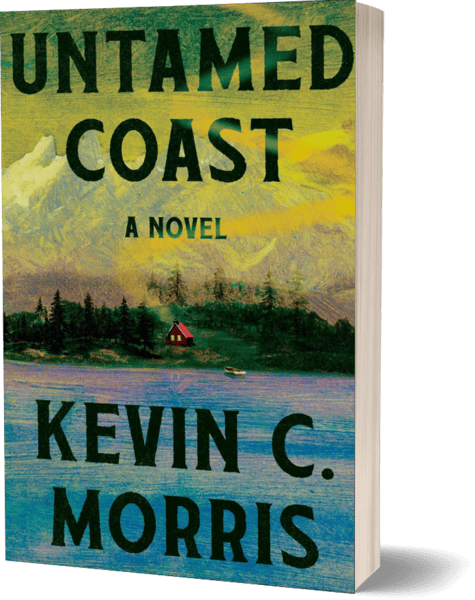
Jane: Welcome to the Jane Healey Happy Hour, the podcast that explores new and exciting novels of all genres. I’m your host, best-selling historical fiction author Jane Healey, and in today’s episode we welcome debut novelist Kevin C. Morris to discuss his atmospheric mystery Untamed Coast, which author Kate Quinn called, “A bold, intricately plotted debut unfolding against the beauty and danger of the Alaskan wilderness.” Welcome, Kevin.
Kevin: Thanks so much.
Jane: Thank you. I’m gonna do a quick intro about you, and then we’ll dive in, to talk about your beautiful novel.
Jane: I’m gonna hold it up, ’cause I, I’m obsessed with this cover. Kevin C. Morris is an engineer, writer, boater, pilot, entrepreneur, and deckhand. Born and raised in Texas, he’s called Portland, Oregon home for the past 40 years, and spends his summers leading boating expeditions up the Inside Passage to Southeast Alaska.
Jane: Untamed Coast is his debut novel. Again, welcome.
Kevin: Thank you.
Jane: So we’re gonna talk at first about the premise, which I thought was so fascinating. I love origin stories about how authors came up with the ideas for their novels. So this takes place along the wild coast of Southeast Alaska, where you have a lot of experience.
Jane: Talk about the origin stories and, this discovery of this 1930s radio output post, or the ruins of it, called Radio Bell.
Kevin: Well, we were, we travel Southeast Alaska by boat in the summers, and we were exploring, in 2016, I believe. And we were gonna go on the outside of Chichagof Island, which is extremely remote, completely uninhabited.
Kevin: There’s just a bunch of tiny little islands that dot the coast out there. And we stopped at sort of the last village that you can stop at before you get into the complete wilderness, which is Pelican, Alaska. It’s a boardwalk town with about 50 people that live there, give or take. And Pelican also has this infamous bar named Rose’s Bar.
Kevin: And so we were there midday, and we decided we’d go in and see what Rose’s Bar was about. There was one other customer in there. It seemed like he’d been there a while already. And, he was a little surprised to see us tourists, I guess, coming through, and asked what we were up to. And we told him we were gonna go spend a few days exploring the outside of Chichagof.
Kevin: And he said, “Oh, you should try to find Radioville.” So we were curious. I’ve always been interested in radio. I’m an electronic engineer. And, he told us a story about this guy that in the 1930s, during the Great Depression, had set up a radio outpost on a tiny little island off the coast, and he was the only communications link between these hundreds of miners working at gold mines and the rest of the world.
Kevin: And he would go by rowboat from his little island to the mines, write down all of the messages, take them back, Morse code, tap them out to the rest of the world, get the answers, and take them back. And that, that was pretty fascinating. And he said, “It’s not charted. You don’t, you know, you won’t… It’s not labeled anywhere on any charts.”
Kevin: But he said the, the building has kind of fallen down and had a red metal roof. And he said the guy was kind of an alcoholic, and, he would throw all of his empties out on the rocks in front of his cabin. And over the next 80 years, those have gotten ground up into just fine ground glass. And he said the whole beach just sparkles with all this multicolored glass.
Kevin: And so When we went out, we s- we started searching for it, and we eventually found the place. We found the old Radio Shack, and, we confirmed that there was some glass in the sand on the beach. Wasn’t quite as sparkly as that guy had described. And I was really fascinated by the idea that, you know, this is a tiny island.
Kevin: There’s no fresh water. There’s no power. There’s no real source of food other than, you know, fishing for salmon and so forth. And so for this guy to set up this radio outpost, it was hardcore subsistence living and, you know, 1930s, and I was puzzled, like, why would he set up shop here rather than at one of the mines where there was already a mess hall, and people, and supply deliveries by ship, and all the things you’d kinda need to, you know, power all the things you’d normally need to run a radio outpost.
Kevin: And yet he chose to set his operation up on this little tiny island and go back and forth by rowboat through some really dangerous waters. And, so that kind of core mystery, I just thought, “This would be a cool setting for a book. I should write one.” And that was kinda what brought me into actually writing fiction.
Kevin: I’d been a journalist for about 20 years before that, writing electronics articles, and so this was my first foray into fiction
Jane: Amazing. I love that. And, and so talk about, you know, you, you obviously have a lot of experience in that area of Alaska. What was your research process like for this book?
Jane: And was there anything, like as you dug into Radioville and that time and place in history, what did … Was there anything that surprised you?
Kevin: My research process was pretty ad hoc. There’s a lot in the story that is based on places we’ve explored in southeast Alaska. It’s an amazing setting. There are over 1,200 islands in the archipelago that make up southeast Alaska.
Kevin: There are three major- Wow … sort of metropolitan areas. There’s Sitka, Juneau, and Ketchikan, and none of the towns and villages are connected by road, so the only way to get around is by boat or by float plane. And all, you know, all of these are pretty small settlements and, and villages and so forth, and there’s a certain isolation that people live with in that, and there’s also an incredible sense of community the way that people will help each other out and support each other because they’re all fighting against the wilderness in, in some way and living off of it in other ways.
Kevin: And so I was really fascinated by that. We’d learn … And also Alaskans are these almost rabid storytellers. If someone … You walk down the dock at the, a boat harbor and someone will grab you and start telling you a story about something with icebergs or bears or whatever that, that happened to them, and, we, we kinda joke that there’s no pause button.
Kevin: Once you trigger one of these stories to start going, then, then they’re gonna keep talking. And so there’s a lot of amalgamation of little things from all those stories that I’ve heard in the book. And, so I didn’t have to do a lot of direct research. I had to do some historical research on what was going on back in the 1930s and so forth, but a lot of it is just experience and sort of bits and pieces of tales that were told to us from, from all these Alaskans
Jane: So interesting.
Jane: So one thing I wanna mention is this is… So it’s a mystery, it’s a story about grief and missed signals, and decades old patterns of disappearances. But it’s a, it’s a, it’s a, it’s three timelines. And I was like, that’s really impressive for a debut. Like, I, I, you, you wove three timelines, 1930s, 1980s, a fishing, a fisherman’s wife, and a present day widower who’s grieving.
Jane: So, talk about how you, you weaved these threads and decided to write it this way.
Kevin: Oh, it was very ill-advised. I
Jane: I’m like, wow, that is ambitious for a first novel. I’m very impressed.
Kevin: So fancy. I guess I’m an engineer and I’ve always loved solving problems, but I, I really bit off a pretty large one for this.
Kevin: My… It was sort of, to me it felt like a necessity. I was fascinated by the story of this guy in the 1930s. Mm-hmm. I didn’t wanna write a purely historical novel because I was also intrigued by my own personal experience, like discovering this place and trying to find out what it was about. And so I kinda wanted at least two timelines, and the two timelines I wanted were 80 years apart, which meant that anybody from that original timeline would probably be dead by the second one.
Kevin: It would be really hard to make them interact or come up with any very interesting connections between them. So I decided I’d throw another timeline in about halfway through in the 1980s, and I wanted to sort of give a nod to some of the, the fishing history in Alaska, and then how, what a major part of the, that that plays, that industry plays.
Kevin: And at the same time, to all of the issues with women that are abused and have gone missing and so forth in Alaska. So I created this, This, fisherwoman, Anya Baron, who’s fishing with her husband, and he’s abusive, and, you know, I think it’s a, a pretty common, a prototype of a pretty common scenario there.
Kevin: And Anya actually became my favorite character in the book, even though she was the last one created, and I created that as a bridge between these other two timelines. And so I, I, I sort of… For me, that was the most successful and the, I think I learned the most creating that story of any of them.
Jane: So I, and, and that’s really interesting she was the last add.
Jane: And so talk about, this is your first novel, what was your character, like developing characters, did you kind of feel your way along as you were writing or did it, or did you, were you very, like, intentional about, like, character sheets and, and things like that?
Kevin: Oh, I tried so hard to be organized and make outlines-
Kevin: and character sheets. Yeah. It just did not, it just didn’t work for me, so I started writing it at the beginning. But, and I, my writing process kind of carried over from my journalism years, is I, I walk around and daydream a lot, and then I will just sit down in little spurts and write a bunch of the last stuff that I, that I’ve been daydreaming.
Kevin: And I, I guess I ended up kind of being character first. I tried to create some, what I thought were interesting and believable characters, you know, put them in bad situations, and just one by one, “Okay, what would this character do in this scenario? What would this character do in this scenario?” And the story sort of flowed from that.
Kevin: And then of course, whatever the character would do, I’d need to find a way to make it not go as well as they’d planned. But so I really, I believe I was character first and character driven in terms of the way the, the narrative flowed out, and I tried to be sure that everyone had good motivations for what they were doing.
Kevin: And I think by doing it character first that- That sets the stage. Also, luckily, you have time travel. If you get halfway through the manuscript and figure out that you wish this character had had this experience in the past, you can go back and give them that experience. So that was kind of a fun, a fun aspect of it.
Jane: Right. That’s right. So in terms of writing, what… I, I always ask this question, are, are you a plotter or are you a pantser? Do you plot things out methodically? Do you write by the seat of your pants? Was it s- was your process somewhere in between?
Kevin: Oh, I, I so aspire to be a plotter and I am so not. I, you know, like I said, I tried writing outlines and making character sheets, and the, the second day I would immediately deviate from those and not go back to them for a month, and then they were so out of date.
Kevin: And, so I think I just intuitively go along. And, yeah, I th- I guess that makes me a pantser.
Jane: Got it. And so, you know, we talked a little bit about structure too, ’cause I’m always obsessed with structure, and this is three timelines all different, you know, different eras, different people. So you said that Anya came last.
Jane: So did you, did you write, like, linearly the other timelines and then weave them together, or d- was it all kind of a little bit of everything?
Kevin: I wrote the book in the order that it appears in the book. So I went straight through writing all three sim- timelines simultaneously. I, I knew a lot of the interactions I wanted to have between the timelines, and I think I, I thought of more as I went along.
Kevin: But for me- Having them interlock properly, what I think would’ve been almost impossible if I’d written them separately and then tried to merge them together. So I, I went along writing them as they are.
Jane: Yeah, I … That, I … That makes sense to me, ’cause I’ve heard of authors who do, like, one at a time and then kind of weave the threads, and I’m like, I don’t know, I can’t imagine doing that.
Jane: So yeah, that makes total sense.
Kevin: I think I would’ve had three books otherwise.
Jane: Right, yeah, exactly, and it would be like 150,000 words, or whatever, like massive … Yeah. So talk about another, … You know, I, I obviously interview a lot of historical fiction authors. What did you learn about balancing historical accuracy and fact versus fiction in terms of like, you know, 1930s, 1980s?
Jane: Like, how … Was there any rules you adhered to in terms of balancing fact versus fiction in this story?
Kevin: I tried to be very a- as accurate as I could possibly be. You know, my Joe Ba- Baxter character was actually based on this real guy that, that ran this radio operation, but it is not him. I, I, I made up my own answer to the mystery of why he was on that island.
Kevin: He was, he was running a, a scam on the side. But, I, I tried very hard … For example, I was trying to locate the Anya Baron timeline in the 1980s, and I wanted her to be listening to the radio, and the first radio station in Southeast Alaska was KCAW, K-C-A-W, in Sitka, and so I had to look when did it go online, and I had to move my timeline so that she was actually right after that went online.
Kevin: So I, I tried very hard to make all of the environmental things and all of the historical things that are mentioned in the book be as accurate as possible.
Jane: Yeah, I, I, I, I know like as, as historical fiction author, I obsess about all that stuff, and I don’t know … I’m not sure if you’ve heard from any readers yet, but you’ll hear about
Jane: Like, when you get a little detail wrong, like, they’ll let you know. Readers will tell you.
Kevin: Oh, they
Jane: will tell you. Was it always called Untamed Coast? I’m always interested in titles.
Kevin: It was not. It was called Radioville as my working title, and, And breaking up with Radioville was hard for me. You know, we, I went through the whole process and got a wonderful publisher and a great book deal, and, and they said, “Okay, we’re gonna need to change the title.”
Kevin: And they explained that, you know, Radioville didn’t evoke this wilderness mystery, it didn’t evoke necessarily Alaska or the coast or anything. And, and so I, you know, reluctantly went along. We had a great process of going through and brainstorming names. It felt like it took months, and we had spreadsheets with dozens of names.
Kevin: I, I really like the one we landed on. You may have noticed in each chapter there’s a little, there’s one word of Morse code that’s the chapter title, and they, they only appear in Morse code. And I thought, well, chapters don’t really need titles-
Kevin: Do
Kevin: that … but,
Kevin: Copy …
Kevin: a lot of people might just think…
Kevin: There you go. Yeah. A lot of people might just think it’s a decoration or something, but it’s also kind of a fun game if people wanna decode it and find out what the, the name of the chapter is. And publisher loved that idea. They said, “Oh, great. Let’s do that.” So I went through and titled all the chapters, and I said, “You know, I should put one under the, the main title as well.”
Kevin: So the, in the cover page under where it says Untamed Coast, the, the Morse code says Radioville.
Jane: Oh. I- I didn’t even… Yeah. Very cool. I’m sorry this is not coming out very- I
Kevin: didn’t tell the publisher that I did that, so I don’t know at what point they realized I sneaked the, the working title back into the book.
Jane: That’s awesome. I love it. That’s so… Yeah. But readers love that kind of thing. Yeah, that’s so cool. And then, again, I love the cover. I’m obsessed with covers. Did you, have a say in the cover design?
Kevin: Oh, huge say. Okay. And they did such a fantastic job. Yeah, we have, From our website where we lead people up the Inside Passage, we have tons and tons of photographs of our exploration, and they said they wanted to do something, environmental and asked for a bunch of our photos.
Kevin: We sent them photos. Nice. They sent us about six or seven concepts that were based on those images. We loved the one that was like this, suggested a few small changes, and, and, I just, I’m thrilled with it. I think they did a fantastic job. They did
Jane: well. They really, really did. Some, a couple more writing questions.
Jane: What part of the process, the writing process, do you enjoy, the most, and what do you find the most challenging?
Kevin: I enjoy all of it. It was hard for me to get out of journalism mode and into fiction writing mode. And I was lucky, I have a friend who became a mentor, Chelsea Cain, who’s a thriller writer, New York Times bestseller, and, you know, she told me first thing to do is forget everything you learned in journalism.
Kevin: And, because she’s a thriller writer she, she sort of indoctrinated me with a bunch of thriller writing tools, and I tried to use those to maintain momentum in the book even though I wasn’t, what I was writing wasn’t strictly a thriller. And I, I really enjoyed learning that part, you know, taking on the challenge of writing in a new way.
Kevin: And I don’t know, I, I, I’ve enjoyed the entire process. There’s not anything that I’ve f- I’ve felt burdened by or felt bad. I’ve just, I’ve had a, a blast. I have a won- Oh, that’s
Jane: great …
Kevin: wonderful writing group that we’ve, you know, brainstormed each other’s pages week after week after week for years now, and they’ve read and critiqued every word of this book at least twice, so,
Jane: Oh, they must be so delighted for you.
Jane: Like, that’s the best, like, you know, whe- when you have writing, writing friends who, like, you know, I, I love to, who support each other along the way. That, this must be such a thrill for all of them too.
Kevin: Yeah. We’re, we’re all having a great time. They’re all superb writers and they have helped so much to make this book the way it is now.
Jane: Awesome. So what has … So y- y- this book, y- this is your debut, it sold at auction. Congratulations, amazing. Thank you. What, what surprised you most about this whole journey?
Kevin: Everything.
Jane: I,
Kevin: I came into this knowing nothing about the publishing business, nothing about fiction. I didn’t know what querying was, I didn’t know if you just kind of went to some office downtown and walked in and said, “Hey, I’d like an agent, please.”
Kevin: Turns out it doesn’t work that way. And so every si- every step of the way I told someone I f- I feel like a pinball that got fired out into the machine and now you’re banging into all these things. Oh, I got some points, I don’t know why, but okay.
Jane: Right, right.
Kevin: And, it’s just, it’s been a big adventure the whole way through and I’m, I’m, you know, h- hopefully I’m learning fast enough to keep my head above water, but, I real- I’m really enjoying that aspect of it.
Jane: Excellent. So what advice do you have for writers about, this is a two-part question, about writing and also about getting published? Especially since, you know, you came to fiction a little bit later, you were a journalist. Like, what, what advice do you have?
Kevin: I think everybody has a different style and process for the way they write.
Kevin: Don’t try to write somebody else’s style. Figure out what works for you and makes you happy and makes you productive, and write that way. Mm-hmm. You know, I always struggled with feeling like I wasn’t a real writer because I didn’t outline and, and I… Other people like, “Oh, I didn’t think I was a real writer because I had to outline,” and other people seem to just come up with it.
Kevin: And so I’d say find the style that, that works for you and a process that works for you and, and stick to it and grow that and, and become that and be proud of it. Edit, edit, edit, edit. You know, I finished the, the first draft of this book, and it’s had so much revision and rework, and don’t try to be finished too soon.
Kevin: Always be making it better. There’s always stuff you can do. So that’s on, on the writing side. On the getting published side, I was shocked when I found out how, you know, how grim the numbers are. When I, I l- looked at the querying point of view from, from what an agent sees, and they’re sitting there with thousands, literally thousands of queries coming in in a year, and they’re gonna pick a handful even to request manuscripts on, and a much smaller handful of those to actually represent.
Kevin: And, you know, I’m an engineer and a mathematician. I said, “Okay, this is a numbers game.” So I, I went into QueryManager and I said, “I’m gonna go alphabetically,” and I just started with the As and looked at each, each agent that was represented at QueryManager and sent them a query if they had a wish list that matched something like what I was doing.
Kevin: And, just keep going. Don’t be discouraged. Don’t take it personally. I think it’s very easy when you get a rejection to feel like you personally have failed, and it’s, it’s not that. The agent is looking for something that matches something that they know there are editors out there looking for, that fits a style that they’re after.
Kevin: It’s not, it’s not a comment on the quality of the work being good or bad, it’s a comment of landing at the right person, the right time, the right mood, and having the right market opportunity behind it. So just keep turning the crank and believe in yourself and keep, keep pushing.
Jane: That is all excellent advice, and I think, you know, to your point about having a writer’s group too, I think that also, it helps to have people who support you and help, you know, critique pages and all of those things, you know, especially when you’re…
Jane: with your first or second book, you know, for sure. Speaking of first or second book, what, are you ready to share what you’re working on next?
Kevin: I’m working on another book.
Jane: Well, that’s good. A- are you ready to talk about it next? What is
Kevin: it generally about? I, I’m not ready to talk about it in any detail yet.
Kevin: You know, it will, it will be recognizable as, as my work, so I’m gonna do a lot of the similar things to what I’ve done in the first book. I’m trucking along and I’m excited about what I’m doing.
Jane: Excellent, and I saw, you have some, events coming up. What is the best way for readers to stay in touch with you?
Kevin: My website, kevincmorris.com, is easy, and I’m on Threads and I’m on Instagram and I’m on Facebook, and, I welcome emails and people reaching out to me, at this point. I can, I can keep up with that. So yeah, tho-those are the easiest ways to be in contact.
Jane: Excellent. Well this was lovely. I’m so, happy for you.
Jane: Congratulations on your debut. I hope it soars. I know it just came out September 1st. And that is a wrap. Lovely meeting you. Again, the novel is Untamed Coast, available n- now wherever books are sold. My latest novel is The Women at Arlington Hall, and I’ll have more about book number six soon, hopefully.
Jane: Please remember to su- subscribe to my YouTube channel or follow me wherever you listen to podcasts. Thanks again, Kevin. Thanks so much for coming on, and thanks everyone for listening.
Kevin: Thanks so much for having me. Thank you.