Jane: Welcome to the Jane Healey Happy Hour, the podcast that explores new and exciting novels of all genres.
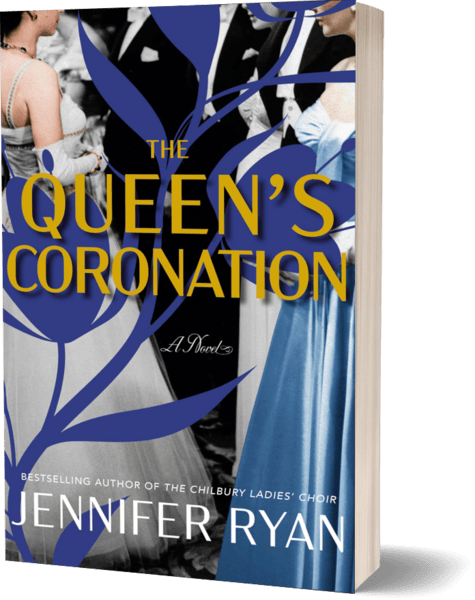
Jane: I’m your host, bestselling historical fiction author Jane Healey, and in today’s episode, we welcome back bestselling author Jennifer Ryan to discuss her latest novel, which is The Queen’s Coronation. Book List says Jennifer Ryan is a master of uplifting historical fiction, and fans of The Crown and Downton Abbey will enjoy the dynamics of this story, and I completely agree.
Jane: Welcome back, Jennifer. Thank you so much for coming on. I’ll hold up the book again too.
Jennifer: Oh, thank you. Thank you so much for having me. Yeah. It’s really, really great to be here, thanks.
Jane: Yeah, and congratulations on launch week. I know you’re like it must be a whirlwind. I’m gonna do a quick bio, and then we’ll jump into questions.
Jane: So Jennifer Ryan is the author of the national bestseller The Chilbury Ladies’ Choir, The Spies of Shilling Lane, The Kitchen Front, The Wedding Dress Sewing Circle, and The Underground Library. Previously a books executive with The Economist and the BBC, she moved from London to Washington, D.C. after marrying, and she now lives in northern Virginia with her husband and two children. Her novels are inspired by her mother’s and grandmother’s tales of life in Britain. Again, welcome. Thanks for coming back.
Jennifer: Thank you so much for having me. It’s really great to chat to you, Jane. Thank you.
Jane: Oh, you’re welcome.
Jane: So I am a huge fan of all things Queen Elizabeth, and there will never be another, and I love the premise of this wonderful story. Why did you decide to write it? Talk about why you decided to write it and what the premise is.
Jennifer: So, basically, it’s very much inspired by my mother’s recollections of the Queen’s coronation back in 1953. And she grew up just out, sort of, in a suburb of London, and it was a town. And she remembers dancing down the street, like, as she was 12 years old, and she was dancing down Beckenham High Street, with her class, in a parade that happened a week before. It was the weekend preceding the coronation itself. And then she remembers all the festivities and the street parties, and watching, all crowding in to a neighbor’s living room to watch it on a tiny screen and everything. But she said, “Oh my goodness, the excitement of the coronation was just immense.” But she said particularly for her as a girl, and all her friends, they were so inspired by this young queen. And suddenly there was this woman, this young, beautiful woman coming onto the throne, and it was for the first time someone that they could relate to. But also, like, instead of all these stuffy old men, I mean, you’d had years of, like, Churchill. Churchill was still prime minister. And it really felt like the entire country was being run by stuffy old men. And suddenly there was this beautiful young woman. And she said from an optical point of view, and you could see it on TV, in photos, in the newspapers, there was this young queen, and she was surrounded by all these other old guys. But she had a place on that top table, you know? Just the sheer fact that there was a young woman there, and she was holding her own. Right from the beginning she had this very core sense of her own sort of moral judgment as to what her decisions were. So all the decisions that she made were based on a very strong religion and where she should stand as a monarch on a subject. So they weren’t made for any personal reason. She was really careful about making very just decisions, like, based on morality and religion. And that really gave her a real solidity actually that kind of went all the way through her reign. So basically she was saying how inspiring it was, particularly in the 1950s, which was a kind of a bit of a dark age for women, after the amazing heights that they reached in the Second World War, like really stepping in to take men’s shoes and showing the world how much they could do. You know, that they weren’t stupid or emotional or all these things that they’d sort of been charged with in the past. Suddenly they were capable people. But as soon as the war finished, they were just like, “No, no, no, you can just go back to being a servant, being a housewife. Being on the factory line, being told what to do by men because we are the natural managers.” And she said, “It suddenly made us realize that there were women out there that could do something.” And she said she found it just very inspiring. It just made all women sit up a little bit straighter and go, “Yeah, if the Queen can do it, so can we.” And so that was my basic point, my starting point, and I really wanted it to be a book that was coming from normal people about how they saw the Queen coming onto the throne, how much she inspired young women, and how many difficulties there were in the 1950s. Such a lot to overcome. And so I decided to… I wanted to make it essentially about the Queen, but the Queen’s story was being covered by the women who were surrounding her. So I wanted it to be the servants of her, rather than her ladies-in-waiting. I wanted it to be just normal people.
Speaker: Mm-hmm.
Jennifer: And I immediately thought of… I’d read a couple of years ago a book by the Queen’s dresser, one of the Queen’s former dressers called Angela Kelly. And although it was quite recent, it made… My obvious thought was, if it’s the Queen’s dresser, it’s someone who spends a lot of time with her and can have personal conversations with her. And also is there when she’s having conversations with other people. She’ll be there sort of dressing her. They’re in between events, or she might slip off to quickly kind of rearrange herself, and you’ve got dressers making sure that she’s looking all right and everything and redoing her hair and everything. But meanwhile, she could be having quite a frank conversation with, say, her mother or her husband. And so it sort of gave me access into her world, where I could have one of the characters really be quite close to her. So that’s how the main character, Caroline, came about. I thought, “Yes, she can be the assistant dresser to the Queen.” And so the other characters, one is a laundry maid who comes from the countryside to London to find fame as a singer, and she takes a job as a laundry maid because her friend already works there in the palace.
Jennifer: And so she—
Jane: And that’s Lucy.
Jennifer: That’s Lucy, yeah.
Jane: That’s Lucy, yep.
Jennifer: That’s Lucy. So she has quite a tough time, because it’s really difficult for her. She was a big fish in a small pond back where she came from. But in London she’s finding it really hard to make any progress becoming a singer. So she ends up doing a beauty pageant and kind of just getting sucked into some of the more seedy parts of London life, which are very sexist, and men can be very manipulative and everything. So she kind of ends up going down that avenue for a little while. Anyway, but I think I really wanted to show her that side of how London was. I mean, in the 1950s there was an ideal for a woman. There’s a song that came out in Britain at the time, which is Living Doll. And the lyrics are, “Got myself a crying, walking, sleeping, talking, living doll.” And that was completely fine. I think it was an incredibly successful song. But the subtext is that she’s gorgeous, manipulatable and enduringly good-looking, you know? And so you have that on one side and all this kind of goody two shoes like housewife who’s really putting her personality on the back burner really in order to be this product that all the magazines talk about. But on the other side, you’ve got this very seedy underworld where women are considered to be just there for sex and—
Jane: Commodities. Yeah. Yeah.
Jennifer: Yeah. And so you get this real juxtaposition between what women are actually supposed to be, but it’s all from the man’s point of view. So and then the third character is American, and I had a lot of fun with that. She’s a journalist from New York whose aunt works in the palace and gets her a job there. And so she infiltrates the palace in order to progress her career, let’s say.
Speaker: Mm-hmm.
Jennifer: And feed back stories and information back to the States. And I had a lot of fun with her. She’s quite a fun character. And she kind of comes with having gone through quite a lot in her life already. She’s a young widow, and she’s become completely desperate for her career to work in an era where women in professional jobs are the first ones to get fired really if cuts are made or even if cuts aren’t made. But it’s the way that they all get inspiration from the Queen herself because they all work around the Queen, and see her and see what she’s like. And they all take away something special that really kind of changes their journey. And of course, they get things from each other as well because they all get to know each other. And even though they’re not necessarily perfect friends right from the start, because they come from very different walks of life. Yeah, so that’s kind of how it all molds together. So it covers, I think, probably about six months before the Queen’s coronation, and obviously, it covers the coronation itself. And it’s the journeys of these three women, but also the Queen herself. The Queen has a lot of problems that she is trying to navigate. When she first took to the throne, she was only 25 years old, and a lot of people saw her as someone who could be very easy to manipulate.
Speaker: Mm-hmm.
Jennifer: And they wanted to take advantage of that. And so she had to basically hold her own really a little bit, and it was quite tough because she’s not someone to kind of get angry or forceful or anything like that. But she just literally said, “I need to stand back and think about this, and then come back.” There was even talk at the beginning of the old king, King Edward, who abdicated, of coming back onto the throne as a regent. And thank goodness that didn’t happen because that would not have worked very well at all. But no, she absolutely stood her ground, particularly against the advisors. I think the advisors were probably her biggest problem because they wanted to use her as a puppet so that she would stand at the front and smile and wave, and they would make all the decisions behind the stage.
Jane: Of course.
Jennifer: But she just didn’t let that happen. She wasn’t as—
Jane: Malleable and manipulatable.
Jennifer: That’s right.
Jane: Yeah.
Jennifer: Yeah. And then her mother was actually quite manipulative as well, so she kind of had to navigate that as well. And her husband, of course. So she was sort of trapped between these three people, and the prime minister.
Jennifer: And Churchill, yeah. Like, Churchill just thought that she was there just to do his bidding basically. So she had a very difficult time of navigating, separating off what everyone actually wanted, and deciding whether it was a good plan. And just politically, how to play off people against each other and everything. She was very clever the way that she dealt with things. When I was reading about it, especially during those early years, I was so impressed by the way she really handled a lot of pressure.
Jane: Extraordinary. And I had forgotten that she was 25, and my daughter’s about to be 23, and I’m like, imagine. That’s so young. It’s so young that she was thrust into that position. It’s amazing. I wanna talk about your research, because your notes in the back, I’m such a research nerd. I loved your notes. You’re meticulous. Anyone who loves research will love your author’s notes in the back. I particularly love that there’s a book about the palace life called Not in Front of the Corgis. That’s amazing. So what was your research process for this story, and did you come across anything that surprised you?
Jennifer: Yeah. So I think it was twofold. I had all the royal stuff, and then I had all the 1950s stuff. The royal stuff was fascinating. I mean, you can honestly just order, like, 30 books just immediately. As soon as I had that idea of writing this book, I kind of ordered 30 books, because that’s what you do. And it was really eye-opening, actually, how much information. I thought it would be really quite difficult to get a lot of really in-depth detail about behind the scenes in Buckingham Palace and things. And it took a bit of digging and some really good sources. And I really managed to get a really good understanding of how palace life would’ve been in those days. One of my favorite sources was a book written by the Queen’s governess, Marion Crawford. It’s called The Little Princesses, and she was blacklisted by the royal family afterwards. They absolutely hated her. That was it for her. Anyway, but it’s incredibly detailed and says an awful lot about the personalities involved of the royal family. And although it was written obviously a little bit before the time, it wouldn’t have been that much ahead of the time. I think it was written maybe about seven or eight years ahead of the time. So it wasn’t as if an awful lot would’ve changed. But it also gave a certain amount of setting the scene in Buckingham Palace and what it was like living in Buckingham Palace. And so that was just fascinating. It really was. I also went to the National Archives, and I was digging through them really a lot. Honestly, I love the National Archives. It’s such a crazy place to go to. And I always just feel incredibly special when you get in, because they’ve kind of almost got to vet you before you’re allowed in.
Jane: Oh, I’m sure. It’s like a thing.
Jennifer: Yeah. And you’re given a special course on how to treat the documents. So you’ve gotta put on these gloves and everything, and you’ve gotta use the weights to hold the books open and things like that. Anyway, but I got an awful lot out of newspapers from the time and magazines from the time. Especially there were a couple of them that had quite a lot of job postings for Buckingham Palace, and that gave me real insight into what the different professions were, what the different servant levels were in Buckingham Palace at the time, and what they were expected to do. Obviously, women were the lowest of the low, honestly. The average pay for women at the time was, like, two-thirds of men, but that was for the same job. But of course, men would never do the same job as women.
Jane: Right.
Jennifer: So they would always do a job where they got paid even more than that anyway. So it doesn’t even equate to two-thirds. It equates to more like a half or even less in real terms. Yeah. So it was fascinating. I actually gleaned really quite a lot from the job adverts and from various other places that work a little bit like a palace but aren’t a palace, if you know what I mean. Looking into other big old houses, aristocratic houses and everything.
Jane: Interesting. So I also wanted to ask specifically about the descriptions of the wardrobe and the clothes and the dressing and the fittings. Were there any primary sources for those behind-the-scenes aspects of royal life? Because I love that. And they were so descriptive.
Jennifer: Oh, well thank you. Thanks very much. Oh my goodness, there’s this part where someone hides in the wardrobe behind the dresses, and I just love that. You know?
Jane: So great.
Jennifer: I mean, it must have been absolutely amazing. So I have to confess, there was a certain amount of imagination. I did read about a wardrobe in one of the other big houses, and so I had a really good idea about how it worked at the time, which would have just been obviously just a room that housed huge amounts of gowns and dresses and things like that. And that wasn’t even the entire collection of what they had. An awful lot of dresses would have been put away because obviously the Queen could only wear the same dress more than once a couple of times. So Caroline’s got her favorite dress from the wardrobe that the Queen had actually already worn, and you just think, “Oh, she could have just taken it, and no one would have known.” You know what I mean?
Jane: Yeah.
Jennifer: Honestly, Caroline is, I have to say she’s my favorite character. She’s one of my favorite ever characters.
Jane: Oh, really? Oh, that’s amazing.
Jennifer: She is so… You know, I love to write these characters, and you create them. Right at the beginning of the writing process, you kind of create a character, then you put them in a situation and let them go. And let them make their own choices according to who they are, who they’ve become inside your brain, you know? And she just was this wonderful woman, and kind of became so much stronger throughout the book. It was just such a wonderful transformation to see it, and to see everything that she went through. If anyone deserved a bit of happiness, it was her really.
Jane: Yeah. That actually is one of the other questions I had for you about the character development process. Is it kind of organic? Do you feel your way along, or are you really thoughtful up front about the character, especially the three main characters and their arcs?
Jennifer: Yeah, I think automatically when you start thinking of characters, as I said earlier, what I really wanted the three characters to do was to kind of show the different sides of women’s issues in the 1950s as well. So for instance, Caroline is married, but she’s got complications. She was pregnant from another man when she got married. Her fiancé that she was pregnant with went to war and disappeared in France, and so she quickly had to get married. And a friend from the palace basically stepped forward and, I think he guessed her situation, and proposed to her and basically said, “But we can’t talk about this to anyone,” kind of thing.
Jane: Mm-hmm.
Jennifer: And so she’s not really happily married. Life is tough for her. And her daughter, who is 12. And then when the fiancé suddenly comes back on the scene, what do you do? She’s there in this situation where she feels this real loyalty to the man who saved her and married her and everything. And yet, there’s the father of her child, and she’s trying to keep everything very secret, obviously, because it would threaten her job, really.
Speaker: Oh, God. Yeah.
Jennifer: Absolutely. If anyone knew about it, she would be out of a job. So there she is, trying to protect what she has, protect her daughter, protect her rights over her daughter. And it becomes complicated and everything. You just really want the best for her.
Jane: Yeah. So in terms of structure, did you always intend to structure the actual story writing from three points of view, or did you start with Caroline and then add the other two? Was it always the plan to write it from the three women’s perspectives?
Jennifer: I do like the ensemble novels. I like writing them. I think it adds so much more to a book, because it’s not only about your central character. It’s got your three central characters and all of their stories, and then it shows their relationship with each other as well, which is almost a story in itself.
Jane: Yes.
Jennifer: So you’ve got that. But I think particularly since one of the things I was trying to do with the novel is showcase what the problems were in the 1950s for women, and how having this very visible young woman on the throne kind of made women actually look at their lives in a slightly different way, and maybe have that bravery, have that spirit to confront some of the ways that they were allowing things to happen.
Jennifer: Take more control of their lives basically.
Speaker: Mm-hmm.
Jennifer: So in so doing, it was very useful to have three or four, or a number of different women characters that you could show all these different aspects of women. And of course, there aren’t just the three main characters. There’s a couple of other women involved who have other story lines. Like Lucy’s friend from home gets married to this account clerk from the palace, and has a lovely house, and is just delighted with all the new things that are happening in the 1950s, and that she can be part of this. And I think that’s another part of it. I think it’s very easy for us now to look back on the 1950s and say, “Well, women all had to be housewives.” But actually, a lot of them, that’s what they wanted to be. That was a real step forward for an awful lot of women. But I think what it doesn’t take into account is that in Britain, half of the women in Britain of working age, they had to work. Even if they were married or not, they had to work. So in a way, this whole kind of glossy magazine of women being housewives and living in these lovely new houses, it doesn’t really represent a large amount of the women in the UK at the time.
Jane: Yeah, what was really going on. Yeah. Absolutely. I have some writing questions that I always ask, as you know. What is your process like? Do you plot things out? Do you write by the seat of your pants? Is it a combination? How do you do it?
Jennifer: That’s a really good question. So I think I have a general idea of where some of the characters are going. One of the wonderful things actually about having more than one character is you don’t have to choose happy ending, not happy ending. Do you know what I mean?
Jane: Yeah, yeah, yeah.
Jennifer: You don’t have to make that decision because ultimately it kind of works out the way it works out, and you know that not everyone is gonna have the happiest of endings and it’s not gonna all be super shiny for everyone. So I have a general idea of what it is that I’m trying to depict, and then I kind of pick the characters. But it’s all about the characters really, and their different journeys and everything. I think with Miranda, who is the American journalist, she’s very witty. I loved writing her. I don’t think I meant her to be very witty or comical, but she’s possibly not quite as efficient as she likes to think that she is. But I didn’t mean her to be that way. That’s just kind of how she grew, you know. I think that’s the thing, like characters, they just take on their own personalities and you write them. It’s really important to do a lot of research around them right at the beginning so that you really understand the era in which they live and what they would’ve gone through. And then you get to know them, and once you really know them, you can put them on this pathway. It’s almost like you set up a situation for them that is different from their normal situation. So you put them onto this road and just see what happens, see how they handle it. And of course, they all handle it in different ways, and you never really can tell until halfway through, and you’re suddenly going, “Oh yeah, no, I wasn’t expecting her to do that, but there she is.” Some of them are just… But I love that. It’s almost like you’re seeing a movie of it play out. Particularly in scenes with dialogue, you can just let them go, and they say the most amazing things, things that I would never say myself. And you’re just writing it down. I love that when you have that energy with writing, that it is sometimes like watching a movie, and you’ve got these characters, and they’re just doing… So I do let it go. I’m not a planner, but I’m not really pants completely. I think I have an idea of what it is that I’m trying to do.
Jane: Yeah. It must’ve been good too because you had this centered around the coronation, so you knew you had to hit a certain event. That was a big lead up to that. That kind of helps with structuring. That must have helped with structuring a little bit because you had this big event that everything was revolving around.
Jennifer: Yeah. That’s right. So everything had to happen before then.
Jane: Right.
Jennifer: Actually, that’s not true. There were a couple of unresolved issues by then that kind of happened afterwards, but yeah.
Jane: On a practical level when you’re on deadline, what’s a writing day look like for you? Do you set a word goal? Do you set a time goal? Do you have a special place you go? What’s your writing like?
Jennifer: So I think with the actual writing, the first draft, I just want to get that done as quickly as possible. That’s like my worst part of the entire process. I have a publishing background. I worked in non-fiction as an editor for many years. I was rewriting a lot of medical books and things like that, or writing it and kind of making it into a proper non-fiction narrative and everything. So I’m very used to sitting at a desk for very long periods of time writing, and I get really into it, and that’s fine. But my natural world is as an editor rather than… So having something that then I can play around with. But the actual writing of the first draft, I don’t really like it very much. I find it a bit of a chore. Anyway, so I just like to get that over and done with very quickly. So I really try and get it done within three months. That’s my… Sometimes the word count isn’t really up there, but it’s sort of like almost a skeleton version of the end product. And then once I’ve got that done, then I’ll hand it around to some other people to read it and then I’ll sit down and go, “Okay.” Normally it needs a lot of changing, a lot of adding stuff, taking stuff away, that kind of thing. And it just goes through a lot of editing processes at that point. And then I just kind of carry on. Now, I’m a little bit bad as far as my work-play time goes actually. Because writers work from home and they work on their own. So if I’m actually not doing anything else, I will be working.
Speaker: Mm-hmm.
Jennifer: It’s as simple as that. I think a lot of writers have this problem.
Speaker: Mm-hmm.
Jennifer: So basically, I don’t really have a set schedule or anything. I get up in the morning. My youngest is still in high school, so I kind of get her ready for school and stuff like that. Not get her ready, but kind of, you know, do the—
Jane: Right, right.
Jennifer: That kind of thing. And then I’m normally at my desk at around 7:00 in the morning, kind of in and out a bit and everything. And basically unless, I mean, I take time off sometimes just because something’s going on, because I tend to work all weekends as well.
Speaker: Mm-hmm.
Jennifer: If there’s nothing else going on, then I’ll be at my desk getting on with this large piece of thing that I’m currently obsessed with.
Jane: Right. I hear you and it’s so interesting. I love to hear people’s process and schedules, and I find when I’m on deadline, I’m the same way as you. The first draft is the hardest, hardest part for me and you just gotta push through, including on weekends and kind of whenever you have the time, just to get that done, right? And actually, so if that’s the most challenging part for you, this is one of my other questions, what is the process you love the most in the whole process of writing a book and finishing it?
Jennifer: I think it’s like that editing part where you’ve done the first kind of lot of edits, which generally are quite big, and you get to the point where you really are kind of close to the end.
Jane: Mm-hmm.
Jennifer: And you’ve still gotta rejig things around a little bit just to make them work better and make the story flow better. And that’s the bit I really like. Because by that point you know the book so well.
Jane: Yes.
Jennifer: And you know where almost every fragment of the book is. So you’re just like, “No, no, no, that has to happen after then and before then, and this fragment has to go before then as well,” and everything. And you’re making things better, and you’re adding little bits that really brush it up and just polish it and everything. And I love that because I just feel it’s like a positive moment, and there’s a little bit of a nerdy part of me which is it suddenly becomes a bit like a puzzle.
Jennifer: Yeah, yeah. I always think of it like a puzzle too. It’s like you—
Jennifer: Have to build the puzzle.
Jane: And then you have to solve the puzzle, right?
Jennifer: Yeah. That is such a good way of… I love that.
Jane: So true. You’ve been doing this a while, and you were an editor before this. What’s the best advice you can give to writers who are listening to the podcast and trying to write their first novel?
Jennifer: So I worked in publishing for a long time, but it was nonfiction publishing. But I think a lot of writers… So I learned a lot of things. One was how to sit down for many hours writing. Secondly was to really do a lot of research, and I learned how to do research and to research things very deeply. And the third thing I realized, well, by the end I was more of an executive level. And publishing houses are businesses, so they are looking at who is gonna buy that book. They’re not risk-takers. There is not enough money in the industry for people to take risks. So for a new author to write a book that gets published, you really need to understand what market is gonna buy this book.
Speaker: Mm-hmm.
Jennifer: And I think, yeah, it sounds very mercenary, but the thing is that I write books that I love writing, that I would love to read. And I think a lot of authors do that.
Jennifer: I think you must do that, Jane.
Jane: Totally.
Jennifer: I think most particularly successful authors do, but it’s finding that meeting ground, that Venn diagram part of what you would love to write but what you can also see in the market that a lot of people might also really enjoy reading. And just sort of understanding. And then with that in mind, you can actually write for this market, which I so love doing, and I find it makes the whole process so much easier because I know who is gonna read it and what they’re really gonna enjoy about it, and what they’re gonna take out of it, and what I want them to take out of it. But I need to know who it is. Now, I’m not saying I’ve got a person in mind or anything, but I’m just thinking of maybe a group of people or some people that I know personally and I think, “Oh yeah, she’d really like something like that. If I put that in, it would give her that little moment of like, oh yeah,” and everything.
Jane: Yes. I think we all love when we read books of something that really connects. And I think that, to your point, if you really enjoy writing about it, if you really enjoy the subject and you’re passionate about it, that comes through in the final product, right? Readers feel that as well. And I’m so glad that you brought up market, because my last interview, Lori Gold, did as well. Obviously we do this because we love to write, but this is also a business, and you have to be cognizant of the market. Even when you’re in that early draft stage, you have to be like, “Okay, I want this to be a book club book for my ideal readers or women’s book clubs,” or, “I’m thinking about it for this.” Like you said, this person, or Stephen King called it his ideal reader, which I think was his wife, and so he wrote for her. So yeah, I really appreciate you bringing that up, because publishing is harder than ever and you have to be pragmatic as well.
Jennifer: Yeah.
Jane: Are you ready to share what you’re working on next?
Jennifer: So not really, because it’s quite early days still.
Jane: Okay. Gotcha.
Jennifer: But it is once again, I’ve kind of got into a pattern, just because I love this. You hear these stories or you come across these stories in some of the research that you do from other books and everything, or someone tells you a story about something that happened to them, or they’ve heard something happened to someone else, and you just think, “Oh, my goodness. That would make an amazing book. I would love to write that book.” Or I would love to write that scene, and you’re already imagining that quintessential moment in your head, and it’s playing like a movie in your head, and you’re just thinking, “Oh, my goodness. I really want to write that book. I really want to write this. It’s about so many things.” And so this is a book that I’ve had in my mind for probably, gosh, 10, 15 years, and it’s someone’s personal story, and there’s something just incredibly touching about it in so many ways, and I haven’t quite worked out the logistics about how it’s gonna work yet. So I’m not gonna tell very much more than that, but it is very much based on a real story.
Jane: Exciting. Oh, excellent. To that point, how can readers keep in touch with you so they can hear about what’s going on with you, and new projects, and events, and all of those good things?
Jennifer: Yeah, so my website, Jennifer Ryan Books, has a sign-up contact sheet. So if you sign up on there, then you can get my emails, which I generally send out about once every few months or sooner if there’s something going on. Maybe a little bit less if I’m busy writing, preparing the next book. So I’m also on Facebook and Instagram, and if you go onto my website, you’ll be able to see the links for that.
Jane: Excellent. Jennifer, this was delightful. Congratulations. It’s June 3rd. I’m not sure when people are listening to this podcast, but this came out yesterday, The Queen’s Coronation. And congratulations, and have a wonderful launch week, launch month. I’m so excited for people to read this book. Again, it’s The Queen’s Coronation. It’s available wherever books are sold. My latest novel is the Cold War spy thriller Woman of Arlington Hall. Please remember to subscribe to my YouTube channel or follow me wherever you listen to podcasts, and thank you again, Jennifer. Congratulations, and thanks everyone for listening.
Jennifer: Thank you so much, Jane.