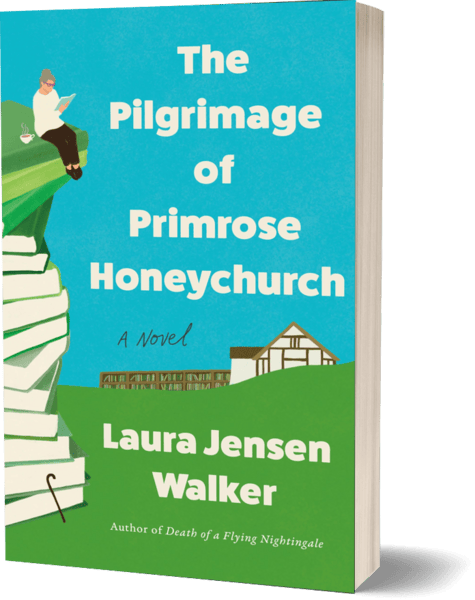
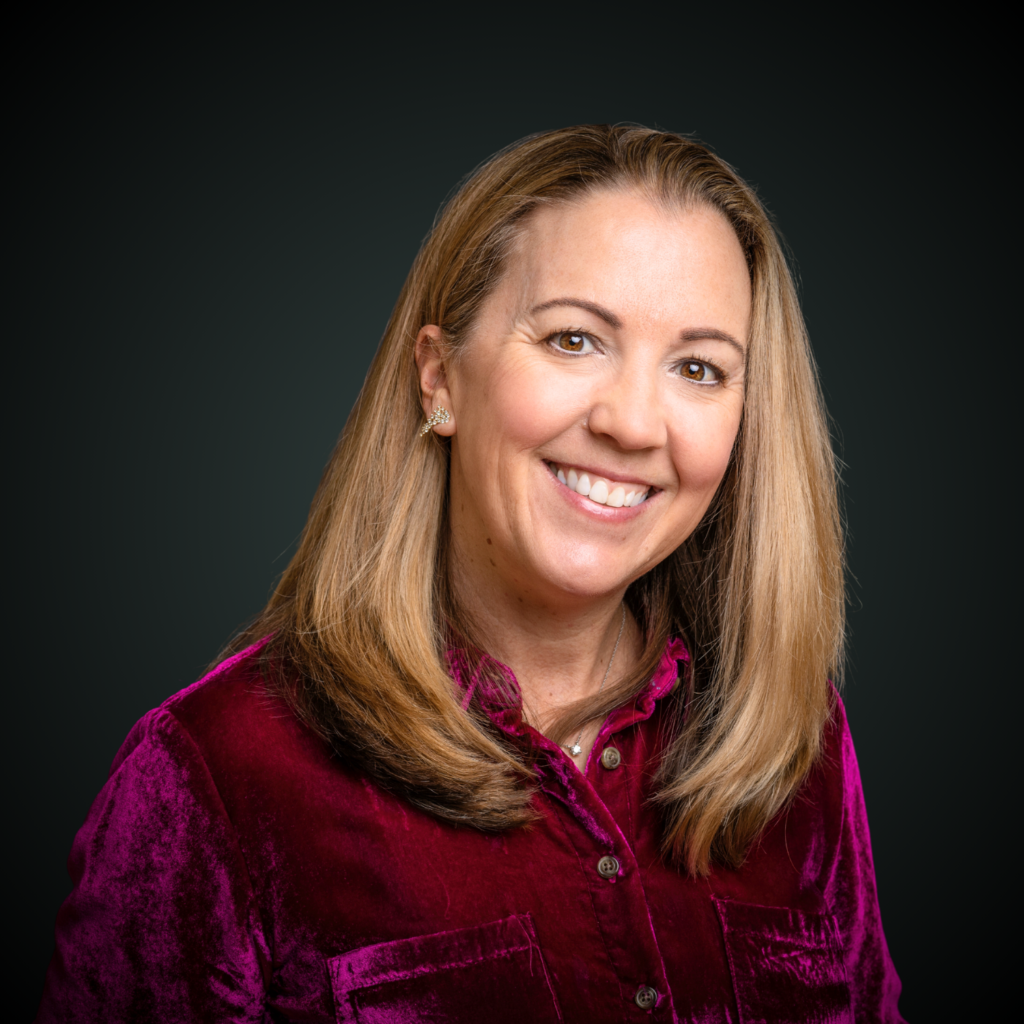
Jane: Welcome to The Jane Healey Happy Hour, the podcast that explores new and exciting novels of all genres. I’m your host, bestselling historical fiction author Jane Healey, and in today’s episode, we welcome award-winning author Laura Jensen Walker to discuss her new woman’s fiction debut, The Pilgrimage of Primrose Honeychurch, which fellow novelist Emily Collin called, “A heartfelt exploration of courage, reinvention, and the quiet bravery it takes to choose a different life.”
Jane: Welcome, Laura.
Laura: Well, thanks for having me.
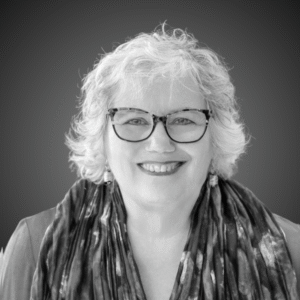
Jane: Thanks for coming on. Quick bio about you. Okay. Laura Jensen Walker is the award-winning author of more than 25 books across genres, including the Agatha-nominated Murder Most Sweet, and the Lefty-nominated Death of a Flying Nightingale. A self-described genre butterfly, she’s also the author of The Postmistress of Pudlington.
Jane: She lives in northern California with her husband and their rescue dog. Again, welcome.
Laura: Thank you.
Jane: So Primrose Honeychurch, this novel follows Primrose Honeychurch, a solitary 70-year-old curmudgeon who sets off on a literary pilgrimage to, I hadn’t heard of this town, Hay-on-Wye, a legendary town. Talk about the origin story here and the premise of this novel.
Laura: Okay. The reason I even came up with the idea is that, a few years ago, when I was 67, I learned that I’m neurodivergent, and it was like, what? I didn’t even know what that meant initially, but when I looked it up, it was like, oh, that’s why I have these sensory issues. That’s why I have these weird quirks and taste texture issues, and so many things that I’ve had my whole life that I thought I was an odd duck. It’s like, oh, there’s a reason for that. It’s called neurodivergent. Your brain just behaves differently. And I thought, well, wouldn’t that be cool to write a story about an older woman, and I made her 70. I won’t turn 70 for a couple more months. But I thought, I would love to have a story about a book-loving older woman who has always been told she’s an odd duck and doesn’t fit in, to then go on this journey and learn, and find out what she’s like.
Laura: And the reason I chose Hay-on-Wye, it’s a bucket list item. I lived in England many years ago when I was stationed there in the Air Force, but I had never had the chance to go to Hay-on-Wye. And it’s called the Town of Books, and it was started in the late ’60s, early ’70s by a Welshman who said, “We need to have a bunch of bookstores and save all these books that are being thrown out.” And so he created this, and he called himself the King of the Town. Real crazy. But it is now the biggest place for used and antiquarian bookstores in the world. And then every May they have a big literary festival with thousands and thousands and thousands of people. So I just thought, let’s have this, my book-loving heroine decide, I want to go to this town. So that’s kind of the premise.
Jane: So talk about this town and your research for this story. What did you learn? Was there anything that surprised you? It sounds like a book lover’s dream, right?
Laura: Oh, yeah, definitely. And that’s why I wish I’d been able to go in person, and I couldn’t. So, but I’d always… I’d seen an article several years ago, that’s where I first heard about it. And I love old books and antique books. I love all books, but especially old books and antique books, and you just saw pictures of shelves of shelves of these stunning books from the ’40s and ’50s. You know, when they had those gorgeous covers and all those colorful spines? And I thought, “Oh my God, I wanna go there and I wanna bring back a whole suitcase of books.” So that has not happened yet, but so I just kinda had to go online and do research. I have a friend who lives in England who was able to tell me a little bit, and just do… So it was all, you know, online research and then some articles I read. But I really hope that I will get to actually go there myself someday.
Jane: Yeah. No, it sounds amazing. My younger daughter is a huge reader, huge book fan. Loves going to old, like real, those really cool old bookstores. I’m like, oh my God, she would lose her mind going somewhere like this. This would be a perfect trip. So talk about Primrose and how you developed her as a character and, you know, I was thinking about, I’m not sure if you read The Correspondent, but I’m like, oh, wouldn’t it… You know, which is about an older woman. It’s an epistolary novel. And I was like, oh, how, you know, how you decided to write about this older woman’s story and how she kind of lets her guard down and changes her mind about her life later in life and, you know, just dig a little bit into that.
Laura: Well, early on, the book starts and she’s living in Las Vegas in a rental where she’s lived for ages, but she lost her mother a few years ago, and she’s a retired library worker. She wasn’t a librarian ’cause she didn’t go to college, just very briefly. But she just doesn’t know how… She doesn’t understand people, so she’s more accustomed to books, and she’s become very solitary and quite a recluse. And so books are her best friend. But she gets a diagnosis from her doctor and realizes, you know, life is short, I’m gonna be brave and try and do something I’ve always wanted to do. And so not only Hay-on-Wye, where she’s always wanted to go, but her mom is from Cornwall. And so she’s half English, but she’s never been to England, and she’s got her mother’s ashes, and she thinks, “I wanna take Mom’s ashes and go over to Cornwall and spread them where she lived.” But I also, the main thing is she wants to go to Hay-on-Wye because, I don’t wanna give too much of a spoiler, she has something she’s going to bring to Hay-on-Wye. So she has never been on a plane in her life, and she’s 70 years old and terrified. So she gets noise-canceling headphones, you know, and just kind of… And all the people around her, she kind of… She’s not a very good flyer, so the minute she lands, she’s like, “I don’t ever wanna get on a plane again.” But she does, she does brave it and go. And I have to honestly say, Primrose is very loosely based on me, except I’ve never been a curmudgeon. Well, not usually. But I just took all those little weird things. Like, she can’t eat certain foods. She hates peas and beans, and she can’t stand tags at the back of her neck. You know, she’s gotta cut them out. And there’s just so much, and too much heat and too much… So I just thought, you know, she would be an interesting character.
Laura: And I’ll tell you that in my first draft she was a little too curmudgeonly, and I had a couple friends read it, and they went, “Oh, I don’t like her.”
Jane: She’s mean.
Laura: And I went, okay, so I softened her a little bit, but I still wanted her… I also had in mind the book A Man Called Ove, which I love that book. And I kind of was thinking of Primrose a little bit like him. But I thought, well, I need to show a little bit more softness for her. So, but she still has to be who she is, and the book does change her, and her pilgrimage definitely changes her.
Jane: Yes. Excellent. Talk about how her… Something derails her pilgrimage, and she ends up staying with her estranged family for a bit, and this niece that she bonds with. You know, what did you wanna explore there in terms of second chances and connection?
Laura: Yeah. I wanted to kind of show… Well, what happens is she winds up, she’s… The other thing she’s never done is drive in England on the wrong side of the road. So she winds up having a little accident where she breaks her arm and all this kind of stuff. So she had planned her mother’s family in Cornwall. She thought, “I’ll see them, but I’m gonna wait until I do what I want, which is go to Hay-on-Wye.” And she wasn’t going to see her family because she’s not good with people. She just thought, “Well, I guess I’ll say hi to them.” But, you know, that was all her plan. But here she is now in the hospital, and the doctor’s telling her, “You cannot drive.” And she’s like, “Well, no.” He said, “You’ve gotta stay here.” And she goes, “No, no, I’ve got these plans.” He said, “Do you know anybody in England?” “Yes, my cousin Daisy.” “Let’s call her.” So she calls her cousin, who didn’t even know she was coming, and it turns out the cousin says, “Well, my daughter is in uni at Oxford. That’s not too far from where you are. I’ll have her pick you up and bring you to us.” “Well, no, I need to go to Hay-on-Wye.” “Well, it’s our 50th anniversary this weekend. We’re booked, you know?” And so it changes everything, and then Clover, her young great-niece, it’s basically like, what, second cousin twice removed, but she calls her a great-niece, comes and her cousin Daisy says, “Well, you need to know, Clover is neurodivergent.” She goes, “What does that mean?” “She sees the world differently, and her brain behaves differently, but she’s a great girl,” blah, blah, blah. So on this journey driving, she starts seeing these things about this young woman, and she starts going, “Well, I’m like that.” And so it kind of opens her mind up to, “I wonder if I could be that way, too.” And, you know, this is a young 20-year-old woman, and she’s 70, so what do they have in common? Well, they love books, they’re related, and it turns out they’re both neurodivergent. So she starts learning more about what that means and really bonds. And Primrose is an artist and an illustrator, and she wants to be an illustrator of books, so they bond over that, too. So it’s quite a lovely older woman, younger woman connection that she hadn’t expected.
Jane: Yeah. Yeah, absolutely. So you’ve written across genres, you know, many books at this point. What is your process like, and is it different depending on the project you’re working on?
Laura: Well, first I have to say I’m a total pantser, seat-of-the-pants writer.
Jane: Okay. I always ask, plotter versus pantser. Okay, yep.
Laura: Yep. As you well know, it’s either plotters or pantsers, and I’m a total pantser. I tried once to plot and do an outline, and forget it. I can’t. Again, my brain doesn’t work that way. Every time I start a book, I’m a little nervous. Is it gonna not work this time? Because, you know, I start… Now, in the case of Primrose, for me, I always have to have the title of the book before I can start. I know not all authors do, but for me, I need to know the title, and I usually need to know the first line. And for Primrose, it was, “Primrose Honeychurch collected words the way others collect seashells.” And I just loved that line, and that gave me an insight into her. And then because she loves words so much, I decided to start every chapter with a word, like chapter one is abecedarian, and then what’s the dictionary definition. Now, of course, I had to change it, ’cause I couldn’t quote the dictionary. But, so I did that, and I just… So the first chapter just kind of wrote itself, just showing, introducing the reader to this curmudgeonly senior who, you know, does not interact with other people well and just wants to stay in her own little world. But then makes the decision, okay, I’m gonna do this. And every day, I’m a morning person, so I get up early, get my tea. I don’t drink coffee. I hate it with a passion, like Primrose. And I just drink my Yorkshire Gold tea, and I sit down, and I just start writing. And I don’t have to write it chronologically, so the story just unfolds before me every day. And, you know, I kind of, I don’t always know the ending. In this case, I did. I knew how I needed to end Primrose, so… And I actually kind of wrote a bit of the epilogue before I’d even written chapter four or five because I had that real clear in my mind. But the rest of it was a surprise, the way it unfolded, which is what I love about being a seat-of-the-pants writer. Every day it’s like, what’s gonna happen now? What’s Primrose gonna do today? So that, to me, is a joy to do that.
Jane: I just love asking about process. I have, like, a bunch of podcast interviews this week, and it’s so interesting, ’cause everyone’s process is so different. There’s no wrong way. Like, it’s whatever gets you through, whatever gets you through to the end, you know? It’s so interesting. And I’m actually in awe of people who are pantsers, because I’m a big plotter, and I just find it amazing that you can just sit down every day and be like, “Hmm, let’s just see what comes out,” you know? Like, it’s really amazing. So you, again, as I said, you’ve written cozy mysteries, historicals, women’s fiction. Do you have a favorite genre to write in?
Laura: So I’m glad you asked that because very recently I was thinking about that because I’m about to be… I’m going to be doing a couple more cozies, but I realized, I have always, always, always loved historical fiction, and I have a special affinity to World War II. So I have now written two World War II novels, which I didn’t plan. That came as a lovely surprise. In fact, The Postmistress of Pudlington is another book, and this just came out in early August. So that was a sheer joy to write. I wrote that during the pandemic when I needed to escape the craziness of lockdown and just go to my favorite place in the world, which is England. So I adore historical fiction, but I’ll tell you, writing Primrose, I went, “Oh my gosh, I really like writing women’s fiction.” You know, although I have to tell you, some of my friends go, “What the heck is women’s fiction? Is there a men’s fiction?” You know, there’s this little controversy about that. I said, “Well, think of it more like book club fiction.” So I would say that my top two favorite genres are now women’s fiction/book club fiction and historicals, and that eventually I’m gonna stop doing cozy mysteries because that’s not my passion the way these are. They’re fun. I mean, it’s a fun little palate cleanser to do, but I just love writing about women overcoming something and learning who they are and finding out who they are through whatever happens. And so that’s what I wanna do for the future. More women’s fiction and more historical fiction.
Jane: Yep, that’s my favorites as well, Laura, absolutely. Do you have a favorite book among the ones you’ve written? I always get this question too, and I’m always like, I can’t… It’s like picking your favorite child. But so what would…
Laura: Well, you know, I’ll tell you, two years ago, I would have said, “Oh, no, I don’t know, blah, blah, blah.” But I will honestly say now, it’s neck and neck with The Pilgrimage of Primrose Honeychurch and The Postmistress of Pudlington. I think, I kind of hesitate to say this, but honestly, I feel that Primrose is the best book I’ve written. When I finished writing it and reading… I’ve read it, you know, you have to read it multiple times during edits and everything.
Jane: Yeah.
Laura: And every time I do, I cry, and I just fall in love with her all over again. So I think she just edges out The Postmistress of Pudlington slightly because that was such a sheer joy to write from start to finish because I was in my beloved England, and I have friends that live in Dorset. And you know, I was stationed in the Air Force in the late ’70s, and there’s a lot of… The Postmistress has been compared somewhat favorably to The Guernsey Literary and Potato Peel Pie Society, which thrilled me because mine is semi-epistolary. Because when I was stationed in Britain, we didn’t have… This was the late ’70s, so there weren’t, you know, computers. We just started with… But there was certainly no email, and you only got to write to people through letters. So I love weaving letters into my books, and in Postmistress, there’s a lot of letters. So that was a joy. And then, of course, then The Correspondent came out, and I went, “I didn’t copy her, honest.”
Jane: Right. I know. No, I will add that to my list because Guernsey is a beloved… I love the book. I love the movie. I probably watch the movie once a year, read the book every so often. Yeah, yeah. Excellent. So you know, you balance humor with more poignant emotional moments in your books. How do you strike that balance?
Laura: That’s a very good question. Years ago when I first started writing, I was in a creative writing class at college, and there were two students’ books that the… or not books, but essays. The teacher always… And mine were always funny and made the class laugh. And then there was this older woman who had been through just hell. Her life had been one trauma after another. Her stuff always made the class weep. And I… This was 20-some years ago, and I said, “Someday I want to write a book that makes people cry.” ‘Cause I used to think crying is, like, better than laughing. I just don’t think that now because we need to laugh. So I definitely try to balance. My cozy mysteries are all funny, you know? That’s very much humor. There’s, like, tiny snippets of maybe some poignancy now and again, but usually it’s just humor. But in both Primrose and Postmistress, it’s more the poignancy, and yet I also try to always weave in a little humor, ’cause we need to balance the light with the dark. We need to laugh and we need to cry. We need both.
Jane: Completely agree, yes. Some more writing questions. What part of the writing process do you enjoy the most, and what’s the part that is the most challenging for you?
Laura: Sometimes I love the first draft. Right now I’ve started something new, which I can’t really talk about. It’s not contracted or anything, but I’m struggling. I’ve gotten, like, 20,000 words and I’m like, “Oh my gosh, now what? What next?” Because I’m a pantser. So when that happens I’m like, “Oh, I don’t know what’s gonna…” So then what I have to do is put it aside and pull up another book. So I kinda write… Sometimes I write two books at the same time because I toggle between them. So that can be challenging, going, what’s next? I also love, and I know every writer’s different, I love the editing process because I always… I can make it better, and I have an editing background, but I love it when I get my developmental edits back from my publisher because they always see something that I didn’t. They go, “What about… Have you thought about this?” And I go, “Oh my gosh, that’s amazing. That’s brilliant. Thank you.” Because we get so close to our books, you know? They’re our babies and we’re so close to them, we can’t think beyond. So when somebody else comes and goes, “You know, I love this, but have you thought about maybe blah blah blah?” And I’m like, “Oh, I had not, but thank you. That’s brilliant.” So I love editors, and I believe every single one of my… I would never do a book without an editor. And I think every one of my books has gotten even better and stronger because of amazing editors. So I love that process because it brings me things that I didn’t consider, and then I go, “Oh, okay,” and then I just run with it. And I’m a real fast writer ’cause I have a journalism background, and I was used to, you had to, you know, turn your story in every day. And so I am a faster writer. Obviously novels take a lot longer than a news article. But I just love the process of getting it down. The first draft is a mess. Like Anne Lamott always says, it’s a, excuse my French, a shitty first draft.
Jane: Yes. Yes, love her.
Laura: It is. And I will rewrite a book, sometimes I write it six or seven times, and my plotter friends go, “What? You know, it’d be so much easier if you outlined it, then you wouldn’t have to write it so many times.” And I said, “I can’t outline. I’m fine,” because my writing it six or seven times goes really fast. So that’s fine. Each one gets better, and each time I see something new. So hopefully by the time I turn it in, it is the best it can be. And then, of course, the editor goes, “But what about…” And I go, “Okay, let’s make it better.” So I love that whole process. It’s a joy.
Jane: I do too. I, yeah, we’re the same that way. I love working with the editors ’cause at that point you become kind of blind to it, and yeah, my editors are… Well, you’re with Lake Union with this one. I’m also with Lake Union. And you know, their instincts are rarely wrong. I rarely push back in terms of, like, how to make it better.
Laura: Right. Exactly.
Jane: So what you’ve… You know, you published your first book at 40. What has surprised you about your writing journey and your writing life?
Laura: Well, actually, every… It surprised me that I’ve done so many different genres. My first book, that came out in 1997, was called Dated Jekyll, Married Hyde, and it’s a humorous nonfiction book, domestic humor, like Erma Bombeck. Do you remember Erma Bombeck back in the day? And so I didn’t expect to do that. I just started writing a magazine article and it became a book. And then bop, bop, bop, I wound up writing 10 nonfiction humor books. But my passion, I love novels. I love fiction, and that’s what I wanted to do. I wanted to write novels since the third grade when I read 103 books in Ms. Popolinski’s first grade class, you know? But I was terrified. I don’t know how you felt when you started your first book, but I was so scared ’cause I thought, “What if I can’t do my dream? What if I suck? What if I’m really bad? What if I cannot do my dream?” Then my dream is ruined. So for a long time I didn’t try, and when I finally did, I was just a basket case ’cause I was like, “I don’t know if I can do it.” But then my first chick lit novel, it was called Dreaming in Black and White, and that came out in 2005, I believe. And you know, again, I knew the title and I knew the opening line, and in that case it was, “My thighs were at it again,” you know? And it was just this funny thing about a single woman, like a Bridget Jones Diary kind of thing. So I had never planned to write chick lit, and then I wrote several of those, and then I needed to take a sabbatical for a while because the money dried up, we needed a new roof, and I needed a nine to five job. So for a decade I went to work for the State of California and I stopped writing books, and I actually had written 17 books in 12 years and I was kind of burned out. And I didn’t know if I’d ever write again, but then the itch returned, and a dear friend of mine who’d been an editor on my nonfiction books, I said, “I want to write fiction, but I don’t want to do any more chick lit. I don’t know what to…” And she goes, “Oh, honey, you would be so great at cozy mysteries.” I went, “What? Mystery. I can’t write a mystery. A mystery’s all about plot. I’m not a plotter.” She goes, “Ah, you can do it. You love tea, you love England, you have dogs. You are a cozy… You live in a cottage.” And so I thought, well, okay. And I sat down and started, and it came. Every single book, every single genre, it has been a surprise to me. Not planned, it just kind of happens, and it’s like, oh. But I can tell you honestly here, I will never write horror or sci-fi. That will never, ever happen.
Jane: Yeah, yeah. That’s fair.
Laura: You know?
Jane: Yeah, got that.
Laura: But it’s been a surprise along the way. It’s been a big surprise, and each time I think, “Can I do it? Oh, God, no, they’re gonna find out I’m an imposter with this one.” I mean, I don’t know if you have imposter syndrome, but…
Jane: Oh God, yeah.
Laura: All the time, you know?
Jane: Yeah, yeah.
Laura: And that doesn’t go away, every single time. No. This is my 26th book, and I still feel that way. But it happens. I show up, I sit down, the words come, and I just do it ’cause I love it so much.
Jane: Yeah, yeah. Amazing. To that end, what advice do you have, this is a two-part question, for writers out there about writing and about getting published?
Laura: Okay. Number one, sit your butt in the chair and start.
Jane: Mm-hmm.
Laura: I cannot tell you the number of… Every time I meet someone and they find out I’m a writer, I’m sure this happens, they always wanted to write a book, or you should write my book or what. It’s like, no. But they don’t do it, and it’s like, sit down. You have to sit down and just start. So, you know, and for me, I mean, I used to always say every day you need to sit down and write. I don’t agree with that now because sometimes life gets in the way, and so maybe it’s only three days a week you can write. But you have to put the time in. That’s critical. And then as far as getting published, in fact, very recently, somebody, an extended friend of a friend of a friend said, “Oh, my friend’s child wrote a book,” and I mentioned I have a good friend who’s a writer, and they want me to, they want you to introduce them to their agent ’cause they need an agent. And it’s like, okay, but A, number one, my agent is closed to queries. Number two, it’s not that easy. And I will be very honest here. Before I got my agent for The Postmistress of Pudlington and Pilgrimage, I had a longtime agent who retired, and I had to get a new agent. Well, I hadn’t had to do that in many years, so things had changed. I didn’t know this whole querying process was such a flipping nightmare. It took me two years, more than 160 rejections on three projects before I got a new agent. And so the other thing I say to people, to writers who wanna get published is, you gotta hang in there. Don’t give up. Like, I see people all the time going, “Gotten 20 rejections. I guess I’m not a writer. I better stop.” No, no, no. Hello. More than 160, and I had a gazillion books published already. So you’ve gotta keep showing up, and don’t give up. You know, yeah, whine and mime. You know, take a drink. Have a margarita. You know, be sad at the latest rejection, but get back up there and do it again because if you love writing, you can’t not write. If you’re a writer, you have to write.
Jane: Yes. Excellent, excellent advice. Are you ready to share what you’re working on now or next?
Laura: Well, I’ll try to say it carefully. Soon I’m going to be… Well, I have… Okay, let me put it this way. I have a new cozy mystery, the sequel to The Alphabet Sluice. That is done and copy edited, and it comes out February. It’s called The Case to Die For, D-Y-E. It looks like I will be writing a couple more mysteries in that series, but I would love to do more books with Lake Union. And so I don’t want to say too much, but I got the idea for a bookshop trilogy.
Jane: Oh.
Laura: And that’s all I’m gonna say. Some would be historical fiction. I have an idea for something, you know, I thought I want to follow Primrose with something contemporary, so I have an idea for something contemporary with a bookshop. I have the titles, but I’m not gonna say them because it’s too…
Jane: Yeah, yeah.
Laura: Under contract, nothing. I don’t want to give anything away.
Jane: That’s so right.
Laura: But my plan, my hope is that I, that’s what I’m… Every day I change between this bookshop book and this bookshop. So one would be set, a dual timeline, which I’ve never done. One set in the ’50s and the ’70s, so that’s a new thing. Again, I’m trying something new. Who knew? But yeah, but that, I hope, I would love… I’m having a lot of fun because I love bookshops, and I love bookstores. And I think that there’s a lot of us, not just writers, but people love those, readers love books about bookshops and libraries.
Jane: Yeah. I totally do.
Laura: I’ve read a gazillion myself.
Jane: Me too. Me too. That’s great. Oh, that’s exciting. Yeah. Good luck with everything. Thank you. What’s the best way for readers to stay in touch with you?
Laura: My website is www.laurajensenwalker.com. I’m also on Instagram under that same name, and Facebook, so they can do that.
Jane: Excellent. And that is a wrap. Laura, it was lovely to meet you. Thank you for being a guest today. Congratulations on your latest, The Pilgrimage of Primrose Honeychurch, available for preorder now, releasing October 20th, wherever books are sold. My latest novel is The Women of Arlington Hall. I’ll be announcing more soon on book number six, hopefully. Please remember to subscribe to my YouTube channel, and follow me wherever you listen to podcasts. Again, thank you so much, Laura, and thank you to everyone for listening.
Laura: Thanks so much, Jane. Take care.
Jane: Take care. Bye-bye.