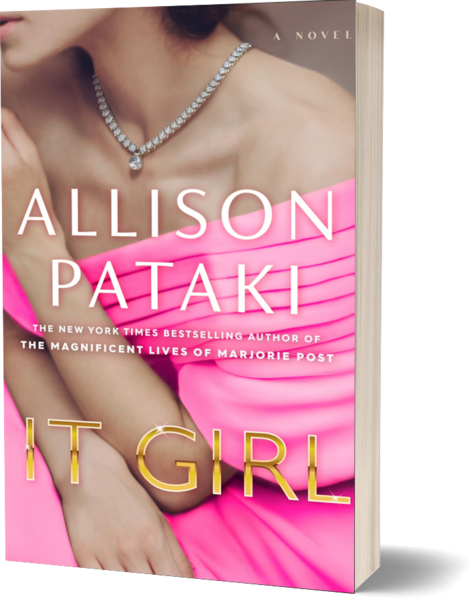
[00:00:05] Jane: Welcome to the newly branded Jane Healey. Happy Hour, formerly historical Happy Hour, the podcast that explores new and exciting novels of all genres. I’m your host, historical fiction author Jane Healey, and in today’s episode, we welcome back New York Times bestselling author Alison Pataki, to discuss her latest novel It Girl, which has came out two weeks ago.
And it has been described as a captivating story of resilience. Splendor and strength at times dark, but at times deliciously. Dishy, and I agree. Welcome Alison.
[00:00:36] Allison: Thank you for having me. I’m thrilled to be back.
[00:00:38] Jane: Yeah, so happy to have you back. So I’m gonna do a quick bio and then like I said, I have probably too many questions for you, but we’ll see how we do.
[00:00:45] Allison: We’ll get into it.
[00:00:46] Jane: All right. Alison Patek is the New York Times bestselling author of, is it 11 novels now?
Yes.
[00:00:51] Jane: Yes. Yes, including the magnificent lives of Marjorie Post, finding Margaret Fuller Beauty in the Broken places and two children’s books. Yes, Pataki’s novels have been translated into 24 languages.
A former news writer and producer, she has written for the New York Times USA Today and other outlets. And appeared on today. Good Morning America. And Morning Joe Pataki, graduated cum laude from Yale University and lives in New York with her husband and family. Again, welcome.
[00:01:17] Allison: Thank you. Thank you. So yeah, I should clarify 11 books because as you mentioned, two of them are children’s bugs.
[00:01:23] Jane: Yeah. And they’re right behind you. Is that
[00:01:25] Allison: They are. Yeah. So Nelly takes New York and Poppy takes Paris. Yes.
[00:01:29] Jane: So cute. So this novel is inspired by the true rags to richest tale of Evelyn Nesbitt. And I loved when I read the origin story, this idea, ’cause it involves your mom. Yes. Tell everyone about how you first discovered Evelyn.
And how you ultimately decided to write a story about based on
[00:01:47] Allison: Yeah. Yeah. My mom gets the credit for the source material on this one. So when I was a little girl growing up in my home, we’re all huge history dorks and we love, stopping for historical markers and my mom had these images on her bedroom wall of these elegant women with these piles of hair.
Luscious thick piles. If you can think about the Gilded Age and that sort of aesthetic and these beautiful, elegant gowns, and these chic get ups and they’d be these beautiful women and they were doing these incredible things like washing their hands or riding a bicycle or like walking a cute little dog through a park across some grass.
And I was just so taken by these images because it was this really interesting blend of. High and low. Nobody I knew in the world dressed that elegantly to wash their hands. And I was like, what are these images? And who are these women? And these were the Gibson girls. These were the women at the dawn of the 20th century who were the models and the artists’ muses.
And they were in advertisements and selling products, and they were like the first influencers, if you will. And so fast forward a few years later. I love writing historical fiction about these forgotten women from history lifting up their voices that have been lost in history. And my mother said you should look into the real Gibson girl.
Her life was tragic and dramatic and glamorous, and she got pulled into this murder mystery called the Crime of the Century, and I was. Enough said that was enough. I was off to the racist and I discovered that there was this real woman who was known as the Gibson girl, Evelyn Nesbitt, and I just became so fascinated with her story at the dawn of the 20th century.
[00:03:31] Jane: Amazing. Yeah. And Alan I thought this was interesting for you because you’ve written. About overlooked women in history, lesser known women in history. And your last book with finding Margaret Fuller was biographical fiction. Like very much like to the, very much about the details of her life.
Yes, she was the main character. But this one you fictionalized, Evelyn. So that was a departure for you?
[00:03:54] Allison: It was so yeah. Biographical fiction, like finding Margaret Fuller, the magnificent lives of Marjorie Post. My books have stuck so closely to the history and when I took up the idea of Evelyn Nesbitt. I realized I wanted to write this one as inspired by, as opposed to strictly based on, and the crux of that came down to the climactic moment in her life and the climactic moment of this book, which was this huge scandal that erupted around Evelyn that was known as the crime of the Century.
If you’ve heard of the musical Rag Time that’s having a run on Broadway right now, there’s the song in it called The Crime of the Century. That is Evelyn’s story and. Evelyn in real life referred to this moment as the moment in which she ceased to be a human. She became a story. She lost her voice. Her voice from that point on belonged to the newspapers.
It was such a huge scandal, Jane, and it was so sensational. It was an international story, so big. President Teddy Roosevelt had to ask the papers. He had to intervene and ask them to give her a break and give her a rest and stop covering it. It was like on the level of Princess Diana’s fatal car crash.
And so when I read that Evelyn perceived herself through all of that as losing her agency in that moment, I just couldn’t stomach writing an arc all the way through where my woman loses her agency. I’m the mother of three girls, and I was like, you know what? I write fiction. I wanna explore this story in a way that gives Evelyn the voice as the narrator and let’s put her center stage and live it and experience it through her perspective.
So I wanted that room to play to lean into fiction. So I wrote it as a novel. This is not a biography.
[00:05:48] Jane: I love that. And so did you find that more challenging or less challenging than fiction?
[00:05:53] Allison: It was more challenging upfront because I had to give myself permission to do this. And you know what I did?
I called Fiona Davis because she’s so brilliant at writing historical fiction that is inspired by yes. And she will have a kernel of a story and a true historic character and a location always obviously. But then she’ll change the names and run with it and develop, novelize it.
[00:06:17] Jane: Yes.
[00:06:17] Allison: And I was like, I really wanna do that this time around.
And I, so I just, I spoke to her. I spoke to Linda Loman another Love Linda.
[00:06:23] Jane: Love both. Yeah.
[00:06:25] Allison: So Great. I spoke to Marie Benedict early on because she has Evelyn Nesbitt’s story, make a cameo and the personal librarian. Oh yeah. And I spoke to Nicola Harrison. I spoke to some other historical fiction authors who have written.
Inspired by, as opposed to based on, and I was like, you know what, 11th book, I’m allowed to do this. I’m a fiction writer. I’m allowed to write a novel. So I really love doing it. So it was harder at first to give myself permission because I know what readers have come to expect from me. But then there’s the author’s note, and that’s where I get to explain why, where, when, how.
And the process and how this worked for the story and for the narrative arc for this one in particular.
[00:07:06] Jane: So interesting. So Evelyn Nesbit, the real Evelyn definitely falls into her life, falls into the stranger than fiction category for sure. Exactly. She goes from like desperate poverty in Pennsylvania, cold country, yes.
To massive stardom and gilded age New York City. Yes. I know you love research. What was your research process like for this story?
[00:07:25] Allison: Yeah absolutely. So as you said, Evelyn’s. Story is a true rags to riches story, and she was referred to as America’s Cinderella story because it was perceived as such a girl who makes good fairytale.
So her family begins in City, city, Pittsburgh, Pennsylvania, with nothing. And they, the tragedy of her early life is that her father drops dead very suddenly and leaves the family and her mother. In particular has this total collapse emotionally, spiritually, mentally, physically, everything. And Evelyn at the age of 13 is thrust into this role of becoming breadwinner and provider and caregiver for not only her mother, but also herself and her younger brother.
And so from there, her trajectory takes her to Pennsylvania, where she becomes a shop girl. She lies about her age, goes to work, gets a job at the age of 13 at Wanamaker’s department store, working as a shop girl, lying about, avoiding eye contact, trying to avoid all the questions. And from there she spotted by a local artist who.
Asks if she would sit as an artist’s muse and a model for her and for Evelyn when she’s offered this and she’s told she would be paid a dollar a day for sitting, that means that her family can eat that day. And so she begins her work as an artist’s muse and model, and that takes her to New York. So for me, with the research, I like to go to the places, and a lot of this played out in New York City.
In this really critical moment where everything is changing, there’s all of a sudden now you have the subway and electricity and the automobile and cameras and photography. And so one of the huge players in this story is Stanford White, the architect who built a lot of New York. So that was a ton of the research was going to those places and walking in Evelyn’s footsteps.
But then the other big piece of the research was reading Evelyn’s own words and Evelyn left two memoirs. Much later in life. She wrote them at two different points in her life, but with hindsight and retrospect. And that for me was all, the other huge piece of the research was just taking in as much of her voice and tone and her textured way of seeing the story.
And that’s when the story really began to swirl in my head.
[00:09:38] Jane: Amazing. So the two memoirs, was there anything that jumped out at you when you were doing the research that surprised you and made you change the arc of the story in any way?
[00:09:47] Allison: That is such a great question. It’s always an ongoing process for me when I’m doing the research because I start with this really meaty outline, like over a hundred pages and that’s the raw material that I’m taking in from her, her two memoirs and then the biographies of her and everyone else who was involved in the time period and Broadway in this moment, and Charles Dana Gibson in this moment, and all the men who are involved.
And I really lay down like the bones of the story before I start writing, and so that is going to inform for me, like I know the major historic events that are gonna be those tent pole scenes, and I know the characters who are gonna be there, and I know my beginning, middle, and end. But what caught me by surprise was and it was an exciting thing to discover, was, I am familiar.
With the Gilded Age and we all grow up if we’re huge history dorks and we’re English majors, we read Edith Wharton. We, know the time period. I love the jazz age, I love the Roaring twenties. I was not as familiar with this intermediate period. Where everything is breaking open.
You don’t just go from the corseted fainting spells of the Gilded age to the high hemline and the dancing of the roaring twenties without a liminal period in between. And that is the exact moment that Evelyn occupied. And so this is the moment where. You’ve got a young, brash new president, Teddy Roosevelt.
You’ve got Mrs. Astor’s walk on high society falling apart. Loosening like it’s society’s no longer going to be dictated by just her 400 friends who can fit in her ballroom. And so in this moment where there are these tectonic shifts, you have this crop of young women who are working, girls who are self-made career girls who are coming to New York City and for the first time in culture.
They are professionals and they are the stars of Broadway and they are working in this new medium, which is photography. So they’re working as models. They’re selling products in newspapers, their images are used for product placement. There is the rise of mass media for the first time where people are reading about them in society pages and wanna know where they’re going, who they’re stepping out with, what they’re wearing.
So it’s interesting to see this time period and see how. Evelyn occupied this singular moment where she was really breaking new tracks in defining pop culture, and she became the first eight girl. She became the first sort of self-made female celebrity before Marilyn Monroe. Before Taylor Swift, you had Evelyn.
And that was surprising to me because I hadn’t really known about her. And this moment in time with the IT girls and the Broadway stars and this time when things were changing not only for women but for society as a whole.
[00:12:33] Jane: Yeah, absolutely. So and so that was a perfect segue to my next question. Oh yeah.
This was like the dawn of celebrity culture in America in a way. And so I wanna quote this from your author’s notes ’cause I love a good author’s note and I’m sorry, of the ghost flashing lights in my basement, right?
[00:12:50] Allison: It works.
[00:12:50] Jane: I dunno what’s going on.
[00:12:52] Allison: Evelyn is joining us because you have the photography right behind you.
[00:12:55] Jane: I conjured her. I know
[00:12:57] Allison: you coming through. She had a. She was always referred to as having haunting qualities.
[00:13:02] Jane: There you go. So she’s here too. In an age where everything felt fast and fresh and bright, these young, independent women danced on the new Broadway stages and dazzled in front of cameras, showcasing beauty and talent, sparking intrigue and desire, and Evelyn shown.
The brightest of all with the star power are so brilliant. It was a blessing and a curse. And I think that in reading the book too, you you showed that from a very young age, people were just captivated by her look and her skin. And her body. And so talk about like you said, this is Donna celebrity culture and she.
Kind of at the center of this new era?
[00:13:39] Allison: Yeah. The rumor that her proud daddy liked to put forth before he passed away, which was like the great tragedy of her life that set off the subsequent, character arcs for her was that when she was born, she was such a beautiful baby that people would travel from states away to come and witness her because no one had ever seen a young girl as beautiful as her. And that, who knows if that’s true or not, but that mythology only built and built to a crescendo over the course of her life where she was described in these ravenous terms where people referred to her eyes as two deep pools into which they could get lost.
And she was just but known as this. She was like the girl that every girl in America wanted to look like and do her hair like and dress like. And every man wanted to possess her and be with her. And as I said in the authors note, it was a blessing and a curse because it shot her to fame and out of poverty and into this other stratosphere of society.
But there’s this really murky line, the whole time between celebrity and exploitation. And she was 16 when she became this international star, and there was this iconic moment where Charles Dana Gibson, who drew the Gibson girls, he was like the taste maker of the paragon of feminine beauty and allure because his Gibson girls were the stars.
And he drew Evelyn in profile. Black and white, and he framed her thick luscious hair, which was famous around her hair, her head in the shape of a question mark, and he called the image woman the eternal question. And this image to use modern terminology, went viral. It became like the defining image of the era.
And of course the tragedy of that is that she was not a woman. She was a girl. She was so young and she was thrown to the wolves of fame, and the wolves really did approach, and they really did circle and they did bite.
[00:15:39] Jane: Yeah. Yeah. I, so one of the reasons for that too is, and I wanna talk about the development of the character of her mom, because
[00:15:46] Allison: yes,
[00:15:47] Jane: her mom allowed that to happen. She was the original stage mom in some, like the bad mom. The mom, yeah. And the fact that she was so young and they kept lying about her age was just, Ugh. Yeah.
[00:15:59] Allison: Yeah. And this kind of selective maternal care where sometimes she was super protective and indignant.
And then at other times she just threw Evelyn into these situations that were truly dangerous. And Evelyn reflected on that later in life. And when she wrote about. Some of the tragedies that. Made her career, made her as a person. She says, I have to leave my body in order to share this because otherwise I won’t be able to.
And Evelyn spoke about this ability she had. M multiple times over her life, but she referred to herself as an auto hypnotist where she could make herself go completely blank. And we would say maybe by modern terminology, like she could just disassociate because of all the trauma. And she ascribed that to part of why she was so successful as a performer and a model she could make herself the blank canvas onto which.
Any other person, man, audience, photographer spectator could project their fantasies or their desires or their image of her. And so that made her a superstar. But it’s sad for what it says about her as a person, and what that meant for her life.
[00:17:07] Jane: And what she experienced.
[00:17:09] Allison: Yeah.
[00:17:10] Jane: So speaking of what she experienced is so the crime of the century is the two men, the two major men in her life.
I wanna talk about them. So Stanford Pierce is this older man, famed architect in New York, patron. Yes. And
[00:17:24] Allison: fired by Stanford White.
[00:17:25] Jane: Yeah. And manipulative, abuser, horrible. And then the millionaire Harry Kendall. So talk about those two characters and the men they were based on.
’cause I think that.
[00:17:35] Allison: Yeah, so I changed the names to Stan Pierce and how Thorn, just because we’re dealing with very serious crimes and mental illness and a huge thing that happened. And everyone has to read the book in order to get to this, the crime of the century.
I won’t spoil anything, but we won’t call it a love triangle. We will call it like a sorted. Toxic tango of the three of them. But these are men who are incredibly wealthy, incredibly influential in incre, incredibly powerful and incredibly taken with Evelyn. Each of them, and both of them claimed to be under her spell and enchanted by her.
And so that comes to blows, and Evelyn gets thrust into the middle of this. It’s so interesting because her whole life she played the role of the femme fatal, the danger beauty. She was, she would pose as Cleopatra who, started those wars between those Roman emperors ’cause she was just too exotic and alluring and manipulative or, she would be cast as Eve, America’s Eve, Adam and Eve or Helen of Troy.
Her fault. She started those wars. Her face was just too beautiful. She launched those ships. And so Evelyn was constantly posed and costumed or playing the role of these dangerous beauties who drove these men mad and drove them to start their wars against each other. And then she gets pitted in this position and gets cast in this role in real life and by the newspapers.
And she is, she’s labeled and called the cause of it all with an uppercase C, her name. And it wasn’t their fault. They were driven mad by their love for her, by her beauty. She was just too alluring. They couldn’t resist. And so it was very interesting to see that play out and it was very meta how it all went down in real life.
[00:19:27] Jane: I I totally agree, and I won’t get into the details of the crime of the century, but one thing that struck me was how. The parallels to today where women are blamed and, I was thinking about like Monica Lewinsky and they’re all, and the press turns on them and digs up things on them and tries to make it all about them, when they’re the victim, and it’s just, it’s so gross. It’s so gross that it’s still happening.
[00:19:51] Allison: The story has been going on for thousands of years back in the other direction and it’s still playing out today and it’s so wild. ’cause like I was. Researching this book. And there’s been a resurgence, I would say, of an interest in Marilyn Monroe, ’cause it’s her 100th anniversary of her birthday this year.
And it’s just, this story has been, rinse and repeat, plug in a few different details, names, locations, but it’s the same story that keeps getting written over and over again. Still playing out to this day. But then what was exciting was that. Just in October in the fall, Taylor Swift put out the life of a showgirl, and she’s playing with these themes as well of what it means.
I pay my dues with every bruise. I take my pearls of wisdom and hang them from my neck. So she’s playing with these themes, but she’s doing it from a position of she’s really the boss. She’s sitting atop this empire of billions. Without the mo, with a very different relationship to a momager with a very different relationship to her own business and her name and her relationships.
And so that felt to me like a sort of like a corrective version of the story that’s playing out for young. Yeah,
[00:20:54] Jane: I know. That was good. That was good timing. I light, I’ll be right there. Alright, that’s making me crazy. Hopefully that’ll work. So if anyone has questions for Alison, you can put them in the chat or the q and a and I will check them.
I have some. More like writing general questions for you. But I’m gonna start with, I’m obsessed with the cover and the pink and the dress.
[00:21:15] Allison: I have to show you something. Cool. I was at a book club a few weeks ago. I was at a book talk and a reader brought me a bedazzle. They bedazzled the cover and it’s I just love this cupboard.
It’s so gorgeous, so
[00:21:29] Jane: pretty. So did you have a say in the cover and in the title?
[00:21:34] Allison: I
[00:21:34] Jane: did. I did. So
[00:21:37] Allison: it Girl is one of the few times where the title that I had from the beginning stuck and we got to keep the title and it’s because Evelyn really. Originated this concept of an IT girl. Before that the girls who were anyone cared about were the society brides and the debutantes and the blue blooded, daughters of the 400.
She was the first self-made it girl who captured the public imagination in such a rapturous way. So I loved that title from the beginning and then. W we could have gone in a different direction with the aesthetics of the cover because if you, once you read the book, you’ll see it’s, it’s Victorian and it’s dark and there’s a lot of red velvet, and you’re in these sort of hidden layers and it’s lush and textural.
But we went with bright and pop and pink because she was at the dawn of pop culture.
[00:22:27] Jane: And
[00:22:27] Allison: so this could be, a totally different decade and. Almost has a little bit of eighties, Madonna meets a little bit of Bravo Real Housewives, but it’s all leaning into the fact that she was at the advent of all of this and we get to do like a reality tv or the VH one documentary, the True Story Evelyn ebit. So it feeds into that sort of like lifting the veil kind of theme.
[00:22:52] Jane: Yeah. And it also, like some elements of her story reminded me a little bit of Elizabeth Taylor too. Yeah. So beautiful, such a young age. She be got, she was an actress from a very young age and famous and Summer Beauty and Cleopatra.
Yeah. The
[00:23:06] Allison: Dangerous Beauty. Yep. Yeah.
[00:23:07] Jane: Yeah. And the many relationships that were so great and, yeah. Yeah. Yeah. So you talked about your process, you’re definitely a plotter versus a panther.
[00:23:17] Allison: I’m a plotter.
[00:23:19] Jane: And how has that changed over the course of your career?
[00:23:22] Allison: No. No. You know what’s so interesting is I put, I always know where I’m ending and I always start and I write my ending first.
And my agent refers to my process as it’s like an algebraic equation. And I figure out like I’m solving for X and I figure out, I set up like this is what you’re solving for, and now you’re gonna go back to the beginning. And make your way up, to the end. And so that hasn’t changed.
What’s changed is just the fact that it’s different every time, right? Because it’s a different batch of characters and raw material in history. And this one was, this one covered fewer years than my other books, some of my other books, but more was packed into those few years.
[00:24:04] Jane: And what part of the writing process do you enjoy the most and what do you find the most challenging?
[00:24:10] Allison: I love so my first draft is really for me figuring out how to tell myself this story. I say that my, the woman about whom I’m writing really leads me scene by scene through that first draft. I don’t know you, I have the plot. More or less in my head and on an outline in terms of the bones of the story.
But in terms of putting the flesh on the story and actually writing it, I’m really telling myself that page by page. So the subsequent drafts are figuring out how to tell that story for the readers. And so I really enjoy those subsequent drafts where it feels less like I’m like. Breaking new tracks, and it feels more like I’m fine tuning and finessing the story, and I enjoy that because that’s when it begins to feel.
A little more real it’s okay this is gonna turn into something. And this is like less like wrestling and more like storytelling.
[00:25:09] Jane: Yeah. Yeah. I always say that first draft is like blood from a stone and then it gets like it’s more enjoyable as far as it goes on. Yeah. Do you
[00:25:16] Allison: feel a little bit of momentum, right?
Yeah. The hardest part for me is usually I’ll say writing the author’s note because that’s when I gotta go like. Explain why I made all the rea, all the choices I made, and I know I’m gonna be hearing from readers and getting those emails being like you said she wore red on July 4th. 18, 14, but actually she wore blue, so
[00:25:40] Jane: Oh yeah.
Yeah. You’ll get those. Yeah.
[00:25:42] Allison: Very hard on myself. And I basically hear the most critical things that anyone could ever say to me. I hear them in my own head first. So the author’s note is blue, this is where it gets real.
[00:25:54] Jane: Yeah. Yeah. I hear that. What is the best, I, we have a lot of aspiring authors who listen to this podcast.
What’s the best writing advice you can give?
[00:26:04] Allison: Write, keep writing, start writing, keep writing, and then be really discerning. When and with whom you share those early drafts.
‘
[00:26:16] Allison: Cause when you are in an early draft, it’s precious to you and it’s vulnerable and it’s like a tiny little flame. And you don’t wanna give that sacred honor of reading your early work to someone who’s gonna blow out your flame.
And I remember sharing an early draft of my first book that has never been published. This book, it was, it was my fir, I didn’t know what I was doing. And I shared it with someone who I trusted and it was well intentioned, but. Her advice and her feedback was so crushing to me that I very well could have stopped right then and there.
And just put away and been like, I can’t do this. And I’m so lucky that someone else overheard that advice being given to me. And that other person had also read an early draft and that other person pulled me aside after and said, what did you think about that advice? And I said, oh, it’s discouraging.
And that person said to me. That’s the book that they want to read, but they’re not you. And you need to write the book that want to read or you wanna write. And they just gave me permission to say, this is really subjective.
To their opinion. And not everyone’s gonna love it, but I need to stick with the story that’s coming through me.
And I, I need to honor that. And so you just wanna make sure that the earliest feedback you’re getting is going to be honest, but also. Aligned with what you’re hoping to do and also you wanna protect your work until you feel like you’re ready to share it.
[00:27:39] Jane: That is excellent advice. ’cause I feel like yeah, when you have those early drafts,
[00:27:43] Allison: it’s so
[00:27:43] Jane: wonderful.
It can just ruin your mojo if someone, if you show it too early and like wrong. Yeah.
[00:27:49] Allison: And like the real, like we’re, we all have very different opinions. I, there have been books that have swept the country that I read it and it just didn’t land for me. And that’s just my, that’s just my experience and what I’m bringing to the page and what I so appreciate about the comment that this other person made to me is the person said.
That person reads really different books than you. So that person wants you to write the books they wanna read. Yeah. But that’s not what you wanna read, and so we all have our opinions and so I, Stephen King also said it well, where when you’re writing, you have an ideal reader in your head and that’s what you’re writing for.
And he said he’s always writing for his wife. Yeah. Find your ideal reader.
[00:28:24] Jane: Early.
[00:28:26] Allison: I know my ideal reader is like my mom, my mother-in-law, my college roommate, like women wear, when they recommend a book to me, I take it the recommendation. I know I’m gonna be aligned. I might not like it, but like I, they, I respect them as readers.
And share it with people who you respect as readers.
[00:28:42] Jane: Yeah. And who you have similar tastes. Yes. The type of books you like to read.
Great advice. So you’re in the middle of a whirlwind tour. Are you even working on something else right now? And do you wanna talk about it?
[00:28:53] Allison: I’m done.
I sent it out because I knew I switched to book tour mode and it’s just such a different head space than writing mode, right? So I was like scrambling to get it done and it’s another American woman. We come, it’s, we come mid-century, a little further into the 20th century this time, and I’m not ready to share her name ’cause as I said, it’s like a little tiny flame and I’m not quite there yet, but almost very soon.
But I guarantee you know her name
[00:29:17] Jane: amazing.
[00:29:18] Allison: But I would venture to guess that you probably don’t know her, the full extent of her story and how she influenced you or your life.
[00:29:25] Jane: Oh, very cool. Congratulations on that.
[00:29:28] Allison: Thank you.
[00:29:28] Jane: I should mention you have a downloadable book kit book club on your website.
Yeah. And including a walking tour of New York City and the Guilded Age, which sounds super fun. I have a couple questions from the audience, but before I take them, how can readers best stay in touch with you?
[00:29:44] Allison: Yes, i’m on social media, so Instagram, it’s Alison Pataki, just my name Alison with two Ls, Alison Pataki.
Same with Facebook. My page is Alison Pataki, my website, alison pataki.com. You can sign up for my newsletter. Lots of ways to find me.
[00:29:58] Jane: Awesome. Okay, couple of great questions here. And thank you everyone for tuning in. We have over 75 people from all over the country Colette Creon. Hello. Colette asks Alison, if you could meet one of your heroines, which one would it be?
Such a good question.
[00:30:13] Allison: Oh, I only get to meet one. Oh my gosh, that is such a good question. Wow. Oh gosh. It is such a toss up. CE would be fascinating, but she probably wouldn’t give me much ’cause she was so reclusive and like shy and sensitive. So I think I’d go with Marjorie because she’d have great stories.
Marjorie Post. Oh yeah, Marjorie.
Yeah.
[00:30:41] Allison: And like I’d love to go to one of her dinner parties.
[00:30:43] Jane: Totally. Good one. Mary and Donner asks, this is a good question too. Do you ever feel sad when you finish?
[00:30:51] Allison: I feel every single feeling possible. When I finished, I feel relief, because you reach a point where you.
Hit a wall and you’re like, I have done my best. I’ve taken this as far as I can go. I need my editor to now read it and work with me. Yeah. I feel like remorse that I’ve ignored my family and that my house is a disaster. I feel the need to do laundry and put on some clean clothes, maybe wash my hair.
[00:31:19] Jane: Yeah.
[00:31:20] Allison: Usually elation and not sadness, because here’s why I finished the book. I know I’m gonna get like a million rounds of drafts for edits. And then I’m gonna have copy edits, and then I’m gonna have proof pages, and then I’m gonna have first pass pages. We touch every word of our books so many times by the end that we are just sick of ’em.
It’s you need to have your baby by the ninth month because there’s just nothing left to give you just gotta move to the next thing. That’s how it feels. And then it’s interesting ’cause then the book goes to production, which is a nine month process.
Physical book, but then.
The book comes out and you spend the rest of your time, hopefully, if readers will have you talking about the book. So the relationship doesn’t end, it just changes. So for that reason, I wouldn’t say I feel sad. I just feel happy usually, and excited to get to the next step.
[00:32:13] Jane: Very, and Marianne says that, which I think this is such a nice compliment.
I try to make the book last when I read your books, which is so lovely. That’s the best.
[00:32:20] Allison: Nice. Thank you. Just give it to everyone you know, and then they’ll wanna talk about it, and then it will make it forever
[00:32:29] Jane: spread.
[00:32:30] Allison: That’s so kind. I love that feeling as a reader too.
[00:32:33] Jane: Me too. I think that’s a great question to end on.
Actually, that’s a wrap. Thanks so much. Congratulations on this wonderful new novel. It Girls Out Now from Valentine. My latest novel is The Women of Arlington Hall. And don’t forget to follow historical happy hour. Nope, not happy hour. Just happy hour. Now, wherever you listen to podcasts is subscribed to my YouTube channel.
I’m sorry for the light show people. I don’t know. My husband, Charlie’s gonna have to fix that behind me tonight. But thank you so much Alison, and congratulations again on this beautiful story. Thank you.
[00:33:06] Allison: Thank you so much. And I just, we just got one more thing pop across. How long did it take you to write it?
Six years. I was working on it like during the depths of COVID,
[00:33:14] Jane: oh wow. Wow. Okay. So yeah, that’s huge project, but I can see why, because the research is incredible too. So yeah. Thank you. Yeah,
[00:33:22] Allison: thank you for having me. Thanks everybody.
[00:33:24] Jane: Thank you. Take care everyone.