Jane: Welcome to The Jane Healey Happy Hour, the podcast that explores new and exciting novels of all genres.
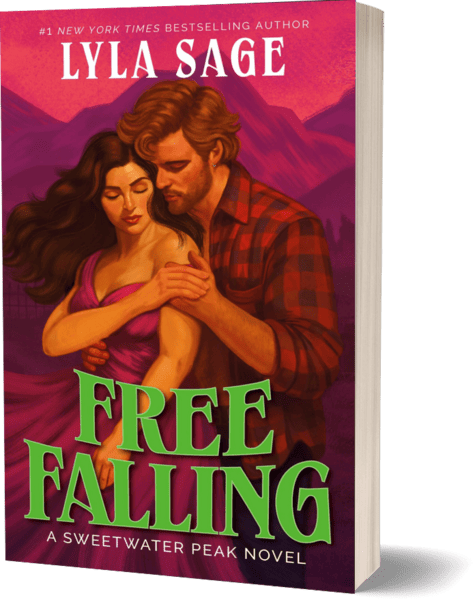
Jane: I’m your host, bestselling historical fiction author Jane Healey, and in today’s episode, we welcome number one New York Times bestselling author Lyla Sage to discuss her latest novel, Free Falling, which fellow author Iman Hiri- Hiriri Kiaa called proof that Lila Sage is the queen of dreamy, spooky, atmospheric small town romance.
Jane: I love that. Welcome, Lila.
Lyla: Thank you so much for having me.
Jane: Thank you again for coming on. I’m gonna do a little bio about you, and then I have, a bunch of questions. So a little… Let’s dive in. Lila Sage is the number one New York Times bestselling author of the Rebel Blue Ranch series, Done and Dusted, Swift and Saddled, Lost and Lassoed, and Wild and Wrangled, and the Sweetwater Peak duology, which kicked off with Soul Searching.
Jane: She lives in the Wild West with her loyal companion, a sweet old blind rescue pit bull, and writes romance that feels like her favorite things, sunshine and blue skies. Again, welcome.
Lyla: Thank you so much. Yeah, it’s always hard… I feel bad when people have to read the titles of my books ’cause I’m so obsessed with alliteration, so-
Jane: I know
Jane: I pra- I practiced before I came on, and I still tripped a little bit, but we’ll fix that in production, so
Lyla: They’re kind of a mouthful.
Jane: They’re great. Okay. So this novel, your latest, is set in the same haunted little town as the first in, in the duology, Soul Searching. It’s set in Sweetwater Peak. I love the origin story.
Jane: It came from a real abandoned ghost town near you. So talk about the origins of this story and, and the premise of the second book.
Lyla: I mean, for both Collins and Clark, ’cause each book follows a twin, Collins and Clark, the main characters of each novel respectively are twins, so I had to have a pretty good idea of what was gonna go on with Clark when I was writing Collins.
Lyla: Luckily for me, they were the first two characters that really came to me, before I wrote either book, and I had a pretty good, like, idea of where both of them were going, and I also knew I wanted the timelines to intersect a little bit, so I had to have a much better idea than maybe I normally do, because I am more of, like, an intuitive writer than an outliner.
Lyla: So but the origins of Clark’s story really started with, like, her love of antiques and her love of old things and, like, old things becoming new again, keeping things within a circular economy, and also both Collins and Clark, their stories are really, like, come from my love and adoration and respect for rural communities and my desire to put rural communities at the forefront of my romance novels.
Lyla: And that was really important for both Clark and Laith in this story, because, like, an antique shop in a town that is not on a through street or off a highway, is obviously not a great business model. So understanding how rural communities survive, like, through tough seasons was really fun and, like, really important for me to explore in here.
Lyla: But mostly it’s just my love for rural communities.
Jane: Nice. Excellent. I love when settings are almost, almost function as character. So talk about Sweetwater Peak and how you developed this small, isolated town, and its lore, and there’s literal ghosts wandering around and, and all of that fun stuff
Lyla: I mean, it was so fun.
Lyla: Sweetwater Peak really is like a character to me. She has her own, like, wants and desires and conflicts and, her own resolution at the end of Free Falling, so, like, I really do think of Sweetwater Peak as a character more than just the place where I’m setting scene. But, you know, I, I love horror, and I don’t read a lot of romance while I’m writing romance.
Lyla: I tend to read a lot of horror, and my favorite type of horror is a haunted house story. I love a haunted house story. It’s… I eat them up. And so Sweetwater Peak is kind of like my take on a haunted house story, and that’s where the origins of it came from, and also lots of old, like, Western ghost town lore and traditions and stuff like that.
Jane: So fun, so fun. I heard that you spent a lot of time watching Antique Rose- Roadshow and learning about Appalachian folklore for this story. Talk about your research for this, and was there anything that surprised you?
Lyla: Yeah. I love Antiques Roadshow, but I watched- Me too. I love it. … so… Like, I was on YouTube, like, constantly watching, like, old episodes of Antiques Roadshow because I also wanted to, like, I wanted the way the antiques made their way to Toad’s to be accurate.
Lyla: So something that might be really popular in one side of the country might not have made it to an antique shop in the mountains of Wyoming. Mm-hmm. And so I was looking for a lot of, like, geographically accurate antiques that would make sense, but also just, like, fun stuff that would appear, like, for collectors and stuff.
Lyla: Mm-hmm. So I consumed so much Antiques Roadshow, and I loved it. And now, like, if I can’t sleep, I’ve been, like, just, like, press and play- … on a episode of Antiques Roadshow, and it just lulls me to bed like a lullaby. Wow. Which is really, really awesome. And then, you know, I was looking at folklore throughout the country, because I feel like every place kind of has its own set of unique folklore, and I was really focused on what folklore looks like in the West and Southwest.
Lyla: So, like, Arizona, New Mexico, Colorado, Utah, Wyoming, but then also, like Appalachian folklore as well.
Jane: Interesting. So this is a love story obviously, but it also, it’s, you know, it’s more than that. Talk a little bit about how you balance, like, the Gothic, paranormal elements with the central romance between Clark and Laith.
Lyla: I mean, I think the thing that helps with that is that I know going into it that, like, Clark and Laith are my focus, and I know exactly where they’re going, what they’re doing, what their story’s gonna look like, and that really allows me to play with the other elements as I go. Mm-hmm. Because it’s always gonna come back to Clark and Laith.
Lyla: They are the main characters. This is their story. This is what’s made for them. And that gives me the ability to, like, really have fun with the external stuff. As long as everything that I’m doing serves them- Mm-hmm … I think I can go in any direction that I want to. So it’s not … It’s less of, like, a balancing act.
Lyla: I often think of my novels as, like, a sitcom where it takes place in kind of one room, even though it doesn’t, and, like, things c- like characters walk in and walk out. Mm-hmm. But that Clark and Laith are always in that room, like, sitting on the couch. That’s how I, like, think about it in my head, and that helps me structure what’s going on around them.
Jane: Oh, that’s really interesting.
Lyla: Yeah.
Jane: And then in terms of character development, do you kind of feel your way along? Like, you have Clark and Laith, and like, … Or do you, or do you do a lot of, like, character sketch type stuff to prep for that? Like, I’m always curious about that process for writers.
Lyla: Yeah.
Lyla: Because I write, like, more intuitively, or, like, a pantser, as some might say, I have to know my characters really, really well before I start in order to be able to pull that off in a way that works and doesn’t feel like I’m a pantser. So I generally, like, try to know as much as I can about these characters before I ever put pen to paper.
Lyla: And so, like, I have a notebook where I write down, like, basically everything that I know about them. I wanna be able to answer, like, any question a reader could throw at me about my characters, whether that’s, like, why did they do this thing, or what kind of toothpaste do they use? Mm-hmm. I wanna know everything about them before I start, and that also helps, you know, keep the core of the story- At the forefront, like what their motivations are, where they, where I would like them to end up, how they get there because I know them so well it makes everything else I’m writing much easier.
Jane: So, oh, that’s really interesting. So you’re a pantser but you, but you do a lot of prep work to like- Yeah … make it easier for yourself. I see. Yeah. Okay, that’s really interesting. Okay. So this is a twin story too. It’s, it’s a story of sister Hood Clarke’s relationship with her twin Collins, who narrated Soul Searching.
Jane: What, you know, how, why did you wanna explore a bond between twins? Like, how did you come up with this idea for this duology?
Lyla: I mean, I’m just really interested in exploring family dynamics and what that means in all of my books, whether it’s a positive one, a negative one, or one like the Cartwrights, which I think is just kind of aggressively normal.
Lyla: They have healing to do. They have a lot of work to do, but they love each other so dearly. But for Collins and Clarke, I think- Of course, the man in my r- heteronormative romance novel is important. He’s gotta be there, and he has a story, and, you know, things to do. Mm-hmm. But I really, obviously, like, really love and adore and want to portray women in a way that feels authentic.
Lyla: And one, like, topic that I haven’t broached before, because none of my characters have had sisters really before, is sisterhood and what it means, the complicated ins and outs of it, but what it means to be able to and want to go to the mat for somebody all the time, even when you’re mad at them. And what it means to reconnect with a sister in adulthood, who you were so close to, codependent on, and then, you know, she leaves and comes back, and it kind of expects everything to be the same.
Lyla: But yeah, I was just really drawn to those two. I think they’re very fun, and every … My favorite parts of both Soul Searching and Free Falling were when Clark and Collins were on page together. Those were my favorite parts to write.
Jane: Awesome. Yeah. And so, I’m, I have some writing questions coming up next, and I’m sorry, I’ll put that on Do Not Disturb.
Jane: We’ll get that out. Mm-hmm. I, I’m always interested in structure, like h- Mm … and how, you know, especially this is a duology, right? So one book was from one point of view, the next one’s from another point of view. And, like, was that your, was, that, has always your plan for th- for these books? And, like, was the structure always, was that kind of one of the first things you decided, or again, were your pants, or did you feel, feel your way along with that?
Lyla: Yeah, I mean, I have, like, a general broad idea, but I try not to get tied to too, like, to something too aggressively, because I like to leave room for myself to grow and change within a manuscript and within a story. But I did have an idea of, like, how I wanted the timelines to overlap and that it was gonna be two books.
Lyla: I didn’t wanna do … I just got done with a four-book series when I started this. I knew I didn’t wanna do that again, but I wasn’t ready to just do a standalone at that point in time. Mm-hmm. I still wanted the opportunity to start a story and end a story across multiple books. So, like, I knew things- Mm
Lyla: and I knew the end point, and I knew the starting point, but how I got there, was pretty fluid. I write in a very fluid way. I normally start in the middle. I don’t write chronologically. Really? Yeah, I’m a nut job. I don’t write chronologically or anything like that. So, that does make things pretty hard, but as long as I know, like, my start, my middle, and my end, I’m pretty- I’ve done this enough times that I can generally figure it out, but sometimes I write myself into a corner that I must write myself out of, which is tough.
Jane: Right, right. But I mean, I, it goes to show you, I love talking process with writers ’cause there’s no right or wrong way, and obviously you’ve been very successful with, with this process. So whatever works for you, works for you, you know? Right. Yeah, yeah. That’s so great.
Lyla: Do I recommend it? No, I do not. Right.
Lyla: But it’s mine, and that’s- Yeah … you know, part of what writing is, is the fact that the process is hard, and that’s, you know, why, like, AI will never be able to replicate what we do because it doesn’t have, like, the pain and suffering of the writing process. It doesn’t have to… It’s hard, and it’s supposed to be.
Lyla: Yeah … and that’s why it works.
Jane: Yes. I, I was listening to an interview with, Rachel Kwan, and she was talking about the cognitive struggle, right? That’s part of the whole process, and that’s what… It’s hard, but it’s supposed to be hard. You know- Yeah … there’s no shortcuts in that. Right. So yeah, yeah.
Lyla: Yeah, there’s, like, a lot of excavating that happens- Yeah … while I’m writing, and, like, I have tried to, like, change my writing process to be, like, better or what… or more efficient. And now I reject the idea that efficiency should be, like, our end goal. But, like, I’ve tried it in the past, because at the beginning of my career, I was like, “Oh, my God, I’m doing something wrong, and I could be doing better.”
Lyla: And the stuff that was coming out of me was not the same as the stuff that happens when I am, like, in discovery mode, and I have found that I thrive in discovery versus knowing everything.
Jane: Yeah, yeah. That makes sense. This… So this is another question to that po- to that point. It’s a two-part question.
Jane: Yes. What part of the writing process do you enjoy the most, and what is the most challenging for you?
Lyla: I hate drafting. Like, I hate drafting, but I love the editorial process.
Jane: Me too.
Lyla: And I think that speaks to discovery, is, like, once I… I’ve done some discovery on my own in drafting, but then I send it to my editor, and she has to start digging, right?
Lyla: She has to ask me the right questions, and that’s most of what my editorial process is, is just, like, questions.
Jane: Mm-hmm.
Lyla: And that really works for me and my brain, and, like, really gets, like, those writing juices flowing. So I love the editorial process. That’s where I find, like, my rhythm- Mm-hmm … and, like, my flow.
Lyla: But I do not like drafting, and some people really thrive in drafting, and they write really clean drafts. I do not. I write really messy drafts that require a lot of, you know, care and attention after the fact. But I do not, I do not enjoy drafting.
Jane: Same, yeah, and I… It’s that angst. The angst of drafting is just so, so hard.
Lyla: I know. It’s so… And it’s just so much easier, like, right, to rewrite or expand upon words when they’re already on the page. And some people aren’t like that, right? Some people get really attached to what they put on the page, so the editorial process, like, brings a lot of, like, strife for them. Mm-hmm.
Lyla: Whereas, like, I, I have the things that I’m incredibly attached to in my first draft, but most of it is fluid based on what I- That’s great … what’s gonna serve the story best. And so that also makes the editorial process, like, really fun for me. Like, it’s very chal- Yeah … it’s very… it’s challenging in a fun way, whereas drafting for me, I’m just, like, beating my head against the wall.
Lyla: I’m like, “Oh, I hate this.”
Jane: I feel that so much. So, so what, you know, what has surprised you most about your writing life since Done and Dusted came out and turned into a number one New York Times bestseller? That… Which is amazing, by the way. I mean, it’s like, congratulations, to you. I lo- I love, I love a s- good success story.
Lyla: Thank you so much. I mean, everything in my life has changed and is a surprise to me. I think that- When I wrote Done and Dusted, I just didn’t think anybody was gonna read it. I thought it was gonna, I, like 30 people were gonna read it on Kindle Unlimited, and I would’ve done the thing that I had always wanted to do, which was write a book, and that would’ve been enough.
Lyla: Mm-hmm. And that’s
Jane: not
Lyla: what happened. No. And quite literally every single thing that has happened to me afterwards has been a surprise. So whether it’s, like, a good surprise or a surprise that puts a lot of pressure on me, it’s all been just, like, shocking. But I wouldn’t trade it for anything.
Jane: Yeah.
Jane: Yeah.
Lyla: Yeah. It’s all mine.
Jane: Amazing. And you went from self-publishing to traditional. And what… So what was that like, that leap?
Lyla: I mean, I was self-published for, like, 35 seconds. So, there are parts of it that I was really grateful for, like, the cover that Done and Dusted and the rest of the Rebel Blue Ranch series has are the covers that I originally commissioned, prior to being traditionally published, pri- prior to being self-published.
Lyla: And so, like, being able to have that sort of control and being able to execute upon my vision- Uh-huh … was really important to me. And at first I said no to the editor that wanted to acquire me, because I was so dedicated to, like, executing Rebel Blue Ranch in the exact way- Mm-hmm … that I wanted to. But yeah, Done and Dusted I self-published June 6th, 2023, and I signed my contract with d- Penguin Random House, the Dial Press, I think on July 3rd or July 5th.
Lyla: Wow. So I was not self-published for that long. I- I truthfully, I’m not built to be a indie author. I’m not business-minded enough to do that. Done and Dusted was, like, me, like, operating out of spite because I had been rejected with another novel. You know, the querying process is incredibly demoralizing.
Lyla: Uh-huh. So it was… Done and Dusted was, like, me running on, like, spite and hope- … which I think are two sides of the same coin, honestly. Mm-hmm. And it ended up working out, but I can’t imagine. I think I would’ve gotten really tired really quickly, if self-publishing was the path for me. I’m definitely better suited to traditional publishing and a l- and my friends…
Lyla: Like, I have friends that are better suited to traditional publishing like me, and lots that are still better suited to self and indie pub.
Jane: Yeah, I don’t think that’s discussed enough. I comp- I, I completely understand what you’re saying, because I have- Yeah … I have a couple friends who are indie pub, and they are business-minded, and it, it is…
Jane: You know, the, it’s, it’s a whole corporation. You have to ru- Yeah … you’re running your own company. People don’t understand. Like, you can… It can be done, but, but to do it well, it’s an incredible amount of work, you know? Yeah. There’s so many aspects to it, not just the writing. And so- Right … I get that.
Jane: And but it’s nice that we live in a world now where, like, that’s a path too for writers, I think.
Lyla: Yes, totally. Yeah. And I think, like, again, I am bus- I’m, like, just business-minded enough to make, like, hopefully strategic decisions about my work. Mm-hmm. But I am not business-minded enough to run businesses the way that I see, like, indie authors just, like, absolutely killing it at all times.
Jane: Yes.
Lyla: I don’t think my workload has changed as much because I was incred- like incredibly involved on the internet before- Mm-hmm … I was traditionally published. So like direct to reader marketing for me hasn’t changed as much, but there was mostly just stuff that other indie authors were doing that I wasn’t because I didn’t know how.
Jane: Right. Yeah. No, I get that.
Lyla: Yeah.
Jane: We have a lot of listeners out there who are writers who are trying to like, get, get that first deal, get that first agent. What advice do you have for writers about writing and about getting published? I realize that’s a two-part question, so.
Lyla: Yeah. I mean, writing, the most unfortunate thing about writing is in order to do it, you have to write.
Lyla: That’s ki- that kinda sucks. I think now where it’s so… And this kind of goes with like the, like publishing question, but like there are options to getting published, and all of those options are gonna suck your time away from writing. So I think the most important thing is to write a book and finish it to the best of your ability before you start looking at everything else, because it’s gonna be so easy to actually just not finish it if you’re worried about everything else.
Lyla: So I definitely recommend like finishing some sort of manuscript, even if it’s maybe not like the dream. You have to start again and do something else to… If you wanna start querying or self-publish or whatever, but like go, doing a book from start to finish before you worry about it, I think is the most important part.
Lyla: I don’t think I would’ve been as successful as I have been if it wasn’t for the books that live on the depths of my Google Drive that no one will ever see, but they’re done. Right, like it’s important to have some sort of finished product so you know that you can produce some sort- Mm-hmm … of finished product.
Lyla: And then as far as like getting published, I mean, there are so many options now, but I think like the most important thing to remember is not to get discouraged, because even the people that you look at, like I consistently get referred to, they’re like, “Oh my God, overnight success, Lila Sage.” And I’m like, “Congratulations to every overnight success on the years of hard work they put in before that overnight happened.”
Jane: Right.
Lyla: Okay. And so there’s so much time that has to… Like, there’s so much, there’s so much work to be done, and like it doesn’t matter how easy it looks for somebody, their journey was hard. Mm-hmm … and so don’t get discouraged. And then if, like if you wanna go like the traditional publishing route, that don’t dis- get discouraged thing is like- Really, really, really important because it’s really hard.
Lyla: And if you wanna go the self-publish route, once again, just don’t get discouraged. Like, more than anything, I think it’s, like, identifying, like, why do I want this?
Jane: Mm-hmm.
Lyla: Do I want this because I see other people’s success, and that sounds good to me, or do I want to do this because I wanna get stories in the hands of readers that I think will love them?
Lyla: And once you find kind of that, like, why, I think it’s easier to continue on the path even if that path is really bumpy and hard.
Jane: Yes, that’s all excellent advice. Yeah, I couldn’t agree more. Are you ready to share what you’re working on next or what you’re working on now?
Lyla: Ooh, yeah. I mean, I have three books coming out next year.
Lyla: Amazing. So I don’t know who made that decision. I made that decision. But my f- the first one of the year is an adult romance novel called Have a Heart. It’s my first standalone. It’s also my angsty-est book yet, my most exploratory book yet, and I’m so proud of it. I’m just finishing up developmental edits on that guy at this moment in time.
Lyla: Those have to be in by Friday. Oh, jeez. Or else I’m gonna get, like, guillotined in Times Square by the penguin- … at Penguin Random House. And then I also have my first young adult debut coming out next year, which is very exciting, with Scholastic, and I’m, like, so excited- Oh, awesome … to contribute- Yeah
Lyla: to the young adult landscape because I am who I am because of the books that I read as a teenager, and, those books shaped me and met me where I was at without judgment, and I am just really excited to see what that space looks like s- for me. And then I’ve got one big surprise for my readers at the end of next year that’s still pretty tightly under wraps.
Jane: Oh, amazing. And actually, that goes into the next question. What’s the best way for readers to stay in touch with you?
Lyla: Yeah, so I’m pretty active on my socials, Instagram and TikTok mostly, but I always recommend subscribing to my newsletter- Okay … if you wanna, like, really stay in touch because it’s so easy to get lo- like, lose things in the social scroll.
Lyla: Like, right, we’re just getting, like, fire hosed consumption all of the time. So, like I say, I send a newsletter twice a month that’s, like, kind of always a roundup of what’s going on in Lila land. And I think that’s the best way to, like, maybe stay more organized, and if you wanna spend more time away from your phone, which I think we all do, we’re all trying to lessen that screen time- That’s right
Lyla: That’s the best way to do it
Jane: Awesome. All right, and that’s a wrap. Lila, it was so lovely to meet you. Thank you again for being a guest. Congratulations on all your success. Like I said, I love, I love hearing these success stories. I think it’s so inspiring, especially for all the writers who are listening as well.
Jane: The latest novel is Free Falling. It hits shelves everywhere on September 22nd.
Lyla: Yes.
Jane: And wherever books are sold. My latest novel is The Women of Arlington Hall. More soon on books number six. Please remember to subscribe to my YouTube channel or follow me wherever you listen to podcasts. Thank you again for doing this, Lila, and best of luck with this latest.
Lyla: Thank you so much, Shana. It was lovely to meet you. Thank
Jane: you.