[00:00:00]
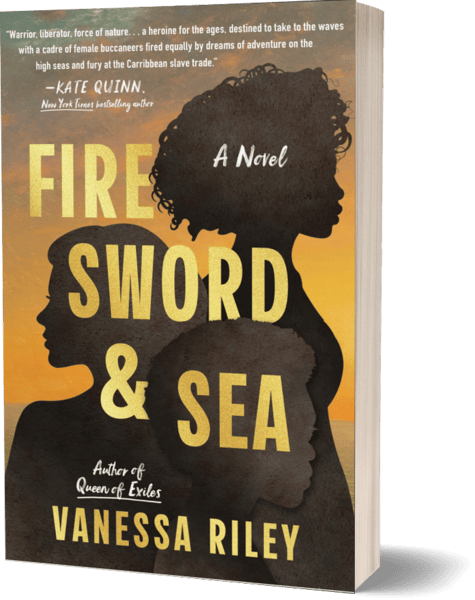
[00:00:05] Jane: Welcome to the Jane Healy Happy Hour, the podcast that explores new and exciting novels of all genres. I’m your host, bestselling historical fiction author Jane Healy, and in today’s episode, we welcome author Vanessa Riley to discuss her latest novel, Fire, Sword and Sea, which has been called a sweeping tale that is pure literary gold.
[00:00:25] Jane: Welcome, Vanessa.
[00:00:27] Vanessa: Thank you. Thank you for having me, Jane.
[00:00:29] Jane: Yeah, so glad we could finally do this. Um, okay, I’m gonna s- I’m gonna read your bio, and then we’ll jump in. Um, Vanessa Riley is an acclaimed author of more than 25 novels, including Island Queen, a Good Morning America Buzz Pick, and Queen of Exiles, an ABC View- View Lit Pick.
[00:00:47] Jane: She is the recipient of Georgia’s 2023 literary fiction author of the year for Sister Mother Warrior, and the 2024 mystery detective author of the year for Murder in Drury Lan- Drury L- Drury Lane. Her work has been praised by The Washington Post, Entertainment Weekly, NPR, Publishers Weekly, and The New York Times.
[00:01:07] Jane: She hosts the essay podcast Rite of Passage on Substack, and can be found at vanessariley.com. Again, welcome.
[00:01:14] Vanessa: Thank you. Thank you once again. This is my pleasure.
[00:01:16] Jane: Yes, I’m so happy we could finally do it. So, um, one of the things I was thinking wh- when, um, when we booked this, a- and I- I- I was like, “Oh my gosh, female pirates in the 1600s?”
[00:01:26] Jane: Like, I don’t think I’ve ever… This is, like, such a unique premise and gen- like, of all the subgenres in historical fiction, not sure I’ve ever done female pirates. So, so, so talk about the orig- I love talking about origin stories of books and, um, this one came to you on a tour of Jamaica.
[00:01:44] Vanessa: Yes.
[00:01:45] Jane: Right? It- Yes … and so talk about the origins of this novel.
[00:01:48] Vanessa: Okay. So I was on… I was, you know, the grueling sun of Jamaica. Yeah.
[00:01:53] Vanessa: Um, it was a writing retreat, and some of us had flown in early, and whenever I go anywhere, I want to see the history.
[00:02:01] Jane: Yeah.
[00:02:01] Vanessa: And, you know, we, birth of a nation, we’re like 250 years old, but there is civilizations hundreds and hundreds of years, and I wanted to see it.
[00:02:11] Vanessa: So, we go to Port Royal. For those who don’t know, uh, Port Royal is the Sodom and Gomorrah of the Caribbean. On one single day, it was hit with a tsunami An earthquake and fire. Wow. So it’s, it, they angered the gods- … really, really bad. But so half of Port Royal is literally still in the ocean.
[00:02:34] Vanessa: Uh, they have to stave part of Fort Charles is there, so we’re going through and they’re allowing us, it’s a really unique tour. They’re allowing us to crawl over cannons and go into where the bunks, where the soldiers were stationed, actually walked where Lord Nelson, uh, was on patrol. And for those who don’t know, Lord Nelson is like the father of the British Admiralty.
[00:02:56] Vanessa: And they’re like, “Would you like to see where the pirates, where we jailed the pirates?” And I was like, “Jail? No, I don’t, I don’t wanna see no jail.”
[00:03:03] Jane: Right.
[00:03:03] Vanessa: You’ve been letting us crawl over things, the last thing in my mind is like that scene from the The Rock where everybody gets locked into prison.
[00:03:09] Vanessa: Where you get
[00:03:10] Jane: stuck.
[00:03:12] Vanessa: Yeah. They were like, “But the female pirates were there.” And I was like, “Female pirates? Okay, let’s go.” And the entire mood shifts once you walk into this prison. It’s different. And one of the tour guides was like, “Yeah, um, Mary Read and Anne, uh, Bonny, they were here, and one of them actually died of a fever in that room.”
[00:03:37] Vanessa: And I was just, you know, I’m hearing about these pirates. The, those women pirates, legendary pirates, they’re from the 1700s. Was asking, “Oh, are there any Black women in the Caribbean? Are there any Black women pirates?” And we all did the universal sign, picked up our phones, and hit Google. And Jeanne de la Hie comes up, and she is a fascinating woman.
[00:04:00] Vanessa: She is a tavern’s daughter. Sh- her mother is African, her father’s French. She’s waiting on tables in her, his tavern in Tortuga. Tortuga is a disputed place. It’s very close to Haiti, but the French and the Spanish, and even sometimes the British, have been all trying to possess this island. Uh, sh- her father’s getting rich because pirates are coming, because pirates are legal in the 1600s, and he’s making this money and, but he wants her to have a prescribed life.
[00:04:28] Vanessa: You are a woman. You’re not gonna be a wench. You’re going to be a wife. Those are our two career options there.
[00:04:34] Jane: Mm-hmm.
[00:04:34] Vanessa: And, uh, she’s been listening to pirates pour out their dreams and hopes, and she wants that. So not to spoil anything, but she dresses up as a man, joins a pirate ship, and is so good at the job she rises to be a pirate captain.
[00:04:50] Jane: Incredible. Like, talk about a stranger-than-fiction story, right? It’s so, so ripe for fiction. I want you to talk a little bit more about who she is. Can you pronounce her name again? I wa- I want to make sure I get that right.
[00:05:01] Vanessa: So it’s Jacquotte.
[00:05:02] Jane: Jacquotte Delahie.
[00:05:04] Vanessa: Jacquotte Delahie.
[00:05:05] Jane: Delahie.
[00:05:06] Vanessa: Yeah.
[00:05:06] Jane: So, uh, you describe her as a woman of cunning and intellect who could fight like a man and sail as well as any man of her time.
[00:05:15] Jane: You know, you discover her, and you’re like, “Okay, I have to write this.” Talk a little bit about your research into her, ’cause y- you also said that she was one of the hardest people you’ve ever had to research and-
[00:05:25] Vanessa: Absolutely. It’s… We’re very lucky to have Anne Frank’s diary, a day-to-day account of what happened to a woman.
[00:05:31] Vanessa: Typically, women’s narratives don’t survive, if they’re written at all. Mm-hmm. We have so many other things to do. And so I… Everybody listening, please journal. Make- … make the jobs of everybody else coming behind us much easier. Mm-hmm. And what you’re doing is important. I think people forget that. But she, s- whether she’s myth, whether she’s an amalgamation, it’s very hard to pinpoint, but her contemporaries, everyone I found linked with her, like Laurens de Graaf, one of the richest pirates that ever sailed, Anne Dever, uh, another pirate woman who, who ends up doing, becomes, uh, owns a tavern and then marries Laurens de Graaf, uh, Michele de Basche.
[00:06:10] Vanessa: All of these pirates, they are very well documented. They are in league with her in some form or fashion. So oftentimes I had to use their narratives, their documentation in order to pinpoint where she is. It’s very clear that the friendships existed. And to me, that’s when the gaps are missing, you’ve got to play, playing with the plausibilities.
[00:06:31] Vanessa: Where would she plausibly be being born here, dying here? This is the course. These are the w- the mentions in other people’s narratives where she was. This is how we find her. So it’s a lot of triangulation, as I know, Jane- Mm-hmm … you obviously know, Oh,
[00:06:46] Jane: yeah …
[00:06:46] Vanessa: from your books. Uh, but I think it’s the, a very fair account of this woman’s life.
[00:06:52] Jane: Fascinating. I, I want… You sent me a couple. I love it when, um, authors send me questions because uh, the, and a couple of them are so great I wanted to include them in here. So this is also about Jacquot. She lives between identities, gender, race, class. How did you approach writing a character who is constantly navigating who she is versus who she must be or must appear to be to survive?
[00:07:16] Vanessa: It was not easy, I’ll say that much. No. Um, and I will say there are a lot of sensitivity reads went into this, the f- the making of this book, and every input really helped build the narrative. It’s, I always start with humanity. Y- you know, where is she human? Where is she vulnerable? How does one gain strength?
[00:07:37] Vanessa: Because, sometimes on these journeys there is the gifted one, the one with the power, the so deemed one, and one of the things I loved about her is she was a screw-up. She was a mess-up, and I didn’t wanna sugarcoat that p- those pieces. I wanted you to see who she was and how she developed so that everybody could understand you don’t have to be the magical one.
[00:08:00] Vanessa: You don’t have to be the gifted one. You just have to have a passion to do something- Mm-hmm … and that was her. So it’s, you know, I, sometimes I draw on, on my own background of, you know, trying to figure out my space in whether it was writing or engineering, um, uh, you know, sometimes male-dominate, you know, engineering’s very male-focused, male-dominated.
[00:08:20] Vanessa: Uh, writing upon occasion can be, feel very male-dominated, male-focused, so it’s like trying to find your niche. Those, that was Jacquot. She wants to figure out in this world. She has these crazy ideas and these dreams, and she wants what she wants, and it was beautiful to write a woman who was unapologetic-
[00:08:38] Jane: Mm
[00:08:38] Vanessa: about what she wanted.
[00:08:41] Jane: And I mean, and just think- thinking about too, this was the 1600s. Like, we’re talking about not 2026. This was a very different time. There’s another question that I loved that you sent me. There’s a powerful thread of women’s leadership and collective re- collective survival in the novel.
[00:08:58] Jane: It’s, you know, it’s more, it’s about found family. How intentional were you about building a crew d- crew dynamic rather than having, like, this lone hero in Jaquat?
[00:09:08] Vanessa: W- once again, I’m- I’m- I’m not really a big fan of the chosen one. Mm. I want everybody to realize they all, everybody’s chosen. And just some of the, the research of the dynamics of these pirate ships.
[00:09:22] Vanessa: Regard- you know, we see perhaps Pirates of the Caribbean in our, our view. The research shows between 20 to 30% of the pirates in the Caribbean were Black. They were of the islands. People weren’t asking your race. They often didn’t even ask your sexuality. They were like, “Can you rig the sails?”
[00:09:42] Vanessa: “Can you s- swing on the side of the, uh, the boat and scrape barnacles off so that they don’t eat through the hull and we sink?” Yeah. And the most important question is, if you’re behind me and you have a sword, are you gonna attack the enemy or y- or do I have something to worry about?
[00:09:56] Jane: Right. Right.
[00:09:57] Vanessa: Uh, so, so for women, I find we are a, a neighborhood.
[00:10:01] Vanessa: We are a village. We care about the ones that are around us and the least of us, and we all want to move together. And to me, in a world that’s male-dominated, in a world where, uh, women are only allowed to be a wife or a wench, how does this woman become a pirate captain where people are willing to die for her leadership?
[00:10:24] Vanessa: Mm. They’re willing to follow her into battle. And so you had to show this dynamic, and so it’s sometimes there’s a little bit of found family. Sometimes it’s admiration of survival. These ships may be away from technically whatever they called home for years-
[00:10:40] Jane: Mm …
[00:10:40] Vanessa: you know, sailing to wherever they w- They become their own ecosystem, and they have to rely upon each other.
[00:10:47] Vanessa: Um, and, and so I wanted that dynamic because to me that’s what the research spoke to, and it, that inner nature of women, we are a collective being. Y- y- Jane, you’re familiar with the hero’s journey. There’s a woman’s, uh, the, the heroine’s journey. Mm-hmm. Um, and it’s, it’s very centered on this col- this approach of collective leadership.
[00:11:06] Vanessa: How do I, I heal or help the whole body as opposed to just me and me figuring out what I need to do in this world? How does this, this enable? And I, I see her as, as that woman trying to lead the entire ship.
[00:11:19] Jane: I love that sentiment, ’cause I’ve been thinking a lot about structure ’cause I’m writing again, and yeah, no, that’s
[00:11:24] Jane: I love that about, like, the, the heroine’s journey. I’m gonna have to write that down for, for my current project. Um-
[00:11:31] Vanessa: Really …
[00:11:31] Jane: I, I wanna talk about the broader research as well, ’cause you have, uh, I should mention, your author’s notes in the front and the back, and you’ve got a great bibliography. I love author’s notes and bibliographies and nerding out about that.
[00:11:43] Jane: You know, you describe the, the 1600s were literal chaos. And also you me- you mentioned that, you know, a- and you just mentioned it in the answer to the prior question pirates were not all swashbuckling white guys. So talk about your research process and and some of your research, and if anything kind of changed the trajectory of the story.
[00:12:05] Vanessa: Yeah. You know, as, as, like I told you, that moment where we all lifted our phones and Googled, uh- … was very important, but Google’s your first kind of your run. Let’s, let’s figure out not necessarily the facts, because, you know, now there’s so many bots, so much AI creation and slop out there.
[00:12:22] Vanessa: But let’s see what people are talking about. So it was very important to see what narratives already existed about this woman. What were they saying? How was she mentioned? And that’s when I started finding all of these other people who are very well documented- Mm-hmm … as being in league with her.
[00:12:36] Vanessa: So that started to form the world. Uh, there were research papers that they’re documenting the num- the, the characteristics of these boats. And at one point I, I also read a lot of pi- pirate letters. I was like, “How do you guys have time to write letters and pillage?” To me- Right? But they’re writing these letters, and I’m, I’m…
[00:12:57] Vanessa: I see a captain’s log, and it’s a manifest of what’s in the, the hull of his ship, and it’s, it’s 16 guineas, a pewter vase you know, 17, uh, guineas, silver bowl. And I was like, “What kind of vase are you gonna pay more for in silver?” I’m like, “What is this?” It’s but it’s just one of these things you kind of file away.
[00:13:21] Vanessa: And, and then I was reading pirate Avery Henry, one of the most successful pirates his letter where he’s explaining why he’s, he feels bad about stealing that English ship to be his pirate ship. Uh, but he keeps going on and he talks about guinea, and he’s talking about guinea as the whole of Africa.
[00:13:39] Vanessa: And when I had originally read that manifest, I was thinking of guineas as in the British unit coin. It was coined in 1610. My story’s set in, like, 1670s. The question of would it tran- have translated that far? Possibly. But everything during this time frame, Spain is the big behemoth on this side of the world.
[00:14:02] Vanessa: All the money is done in Spanish. Those are reals. Those are pieces of eight. And then I went back to that manifest That’s what that captain had been selling. He sold 17 people for that bowl. He sold 23 for that urn. And in this world where you could have a completely integrated top of the boat, top of the deck with men, women in secret Africans, Caribbeans, everybody’s on this boat with the Dutch and the French, and under the bottom you could still be dealing in chattel slavery.
[00:14:42] Jane: Yeah.
[00:14:43] Vanessa: That dynamic and what that means and how they lived, I wanted it to translate into the novel as, like, a moment in time. This is this moment in time where you s- have pseudo equality, but your- Mm-hmm … bowels are still reeking of this non-equality and I wanted that to transmit.
[00:15:00] Jane: Yeah. It’s chilling when you, uh…
[00:15:02] Jane: The way that you just described it really is. And, um, yeah, there’s so, so many aspects of this story. Was there any other pieces of research that really, like, kind of stood out to you that you wanna, that you wanna highlight?
[00:15:16] Vanessa: Oh, crazy things that in this big rush to, to seize Tortuga, they wanted to have old pirates live there and set up a colony.
[00:15:29] Vanessa: Uh, in order to have a colony you need young women to marry these pirates to have families. So they literally got a writ, permission from the King of France, to steal French women- Ugh … from the streets, or if they’d been minor crimes, to take them from the prison, shackle them, throw them in the bottom of a boat…
[00:15:51] Vanessa: Sound familiar?
[00:15:52] Vanessa: And take them months and months away to Tortuga, and give them the option of working in the brothels or marrying or being sold to a pirate to marry.
[00:16:03] Jane: Some option, right? Like, oh.
[00:16:05] Vanessa: I know. You know?
[00:16:06] Jane: Yeah.
[00:16:06] Vanessa: But I think if you’ve been in the hull of a boat shackled, you probably will make the, whatever decision you…
[00:16:12] Vanessa: And, and we shouldn’t- Mm … fault these women at all. Th- this was, this is horrific.
[00:16:16] Jane: Horrific.
[00:16:17] Vanessa: And I, I the tantamount that anybody could be enslaved-
[00:16:22] …
[00:16:22] Vanessa: Was another message I wanted to bring about, because you have French women here- Mm-hmm … who are, are being enslaved. Uh, there are points where they go to, uh, Ver- uh, d- different p- different bodies have, or governments have sanctioned going to Veracruz and getting the Afro Mexicans, uh, and, and enslaving them.
[00:16:40] Vanessa: And the, the terms of enslavement are different across every island, every… But it’s still the underpinning of all actions, this, this thing of enslavement.
[00:16:50] Jane: An economy. All at, you know, part of the economy.
[00:16:52] Vanessa: It’s part of the economy. Yeah. Yeah. Warehouses are set up right on shore so that pirates can take their stolen goods- And transfer into the universal currency, which is enslavement.
[00:17:03] Vanessa: I, that’s the underpinning. So y- I wanted to show the realism the, uh, the- Mm-hmm … there are some swashbuckling kind of moments and, and the, the, the, the battles, every battle is modeled after a real-life pirate engagement, because I wanted you to see that, the blood, the sweat, the tears, the intensity.
[00:17:24] Vanessa: Mm-hmm. Um, and it’s all, as you a- asked earlier, this is all part of my research, because I want you to feel like you’re there, but safely.
[00:17:31] Jane: Right. Yes, yeah.
[00:17:32] Vanessa: Safely there on the deck, watching and observing. Like
[00:17:34] Jane: I’m, cinematically, right? Watching it like a
[00:17:36] Vanessa: movie. Watching, yes.
[00:17:37] Jane: Yeah. On that note, I love to talk process, and this has, this is just like so dense i- in terms of research, and it’s a sweeping novel.
[00:17:48] Jane: H- what i- is your pl- process like? Are you a, do you write by the seat of your pants? Do you plot things out? Yeah, do you do research first, a- or research as you go? What’s your process like?
[00:18:00] Vanessa: Okay, so I’m gonna say the answer’s all of the above. I am firmly a planster.
[00:18:05] Jane: Okay.
[00:18:06] Vanessa: A planster, because I, you can’t tell this story and, because especially when you are finding somebody’s life and you’re displaying it, you have to be fair to that person, you have to be honest.
[00:18:19] Vanessa: Mm-hmm. So I have to know everything earthly possible about this person before I, I even pick up my pen to start thinking about writing about it. Um, and I’ve got these, these pinpoints of these are the factions in their lives. And, you know, as an author, you have a choice where you start that book, and you have a choice where you end that book.
[00:18:38] Vanessa: And because I find so many people, Have get really tense when they think about history. And they, they feel the pain, but they miss the joy. So they’d wanna- Mm-hmm … ignore it altogether. So where I end is always a high particular moment, something changing because I want you to leave this book saying, “Wow, I wanna know more about this history.”
[00:19:00] Jane: On an up note,
[00:19:01] Vanessa: right? On an up note. Yeah. Yeah. On an up note. I, I am not a, a, a pain porny girl, as I- Mm-hmm … we call it, where just you’re gonna see all this suffering and then at the last minute you’re gonna see, woo, they win. No.
[00:19:11] Jane: Right, right.
[00:19:12] Vanessa: I, I wanna take you on a journey that you may wanna repeat. So I’m very conscious of that.
[00:19:17] Vanessa: So that’s why the plot, you know, I, I’m a plot. I’m a stake post. It happened here, and I’m a stickler stake post. You know, I’m not gonna put you someplace that’s not plausibly, doesn’t show me that I’ve found something that says you were, you could’ve been in this place, or you were actually in this place.
[00:19:31] Vanessa: So I’ve got signposts and fence posts. Um, and then I do a lot of character. What kind of woman would willingly defy her father during the 1600s dress up as a man, um, and then want to fight and battle and, and, to be so good at a s- what kind of thing? So, you know, I’ve got to put pieces in
[00:19:53] Vanessa: To me, I have to put pieces in that story that make the story make sense.
[00:19:56] Vanessa: Because she’s not chosen, she chose herself.
[00:19:59] Vanessa: Chose herself to do these things. Um, and so I’ve got that. And then, but I do l- once I have this structure in place and I know where I wanna start the story, um, and I know the scenes, I start writing the scenes, but that’s where I’m panting.
[00:20:13] Vanessa: I know the scene goal, but I don’t know how that dialogue’s gonna come across. I kinda think I know, but sometimes it will change once it’s on the paper. And then you kind of step back and you look at this overall arching arc and like, okay, that arc is not working, but this arc is really strong. Let’s go back and bolster that.
[00:20:31] Vanessa: So I’m a layer writer, so I will go back and do layer and layer until we get to that optimized state of this is the story I wanna tell.
[00:20:39] Jane: Excellent. And, uh, to that note, it does your engineering background influence the way … ‘Cause you’re talking about it almost like product management, right?
[00:20:47] Jane: Like, you add the- You add the features to the product, so
[00:20:52] Vanessa: like- Jane, winner, winner, winner, winner. Yes. It’s a method I, I’m calling story craft, where I’m very much an it- you know, when I had my very first book, I got this horrible rejection. Like one of those, like, you never wanna pick up a pen ever.
[00:21:07] Vanessa: And, you know-
[00:21:09] Jane: I bet …
[00:21:10] Vanessa: it made me say, “Wait a minute” How is my engineering brain? First of all, we don’t accept defeat because, you know, that’s just something engineers don’t do. But how do we iteratively look at this? So that novel I literally rewrote 125 times.
[00:21:26] Jane: Wow.
[00:21:27] Vanessa: And each time was, let’s work on dialogue this version, let’s work on setting this version, let’s work on character motivations.
[00:21:34] Vanessa: Literally boop boop, boop, boop, and iteratively. So even now, I’m an iterative girl. I- let’s get this bare bones structure in place first And, you know, even though I do research in the beginning to know about this woman and, and whatnot, I will leave holes in this for going
[00:21:52] Vanessa: because I’m not gonna stop the, the, the writing momentum. I just put triple Xs in the, in the manuscript and say, “Okay, that’s something I gotta go back and fix.” I do
[00:22:01] Jane: that too, yeah. Yeah. ‘
[00:22:03] Vanessa: Cause you’ve got … You will get … there’s no … There’s never enough.
[00:22:07] Jane: Mm-mm.
[00:22:07] Vanessa: You know? You will keep going, and you will dig your hole and whatnot.
[00:22:11] Vanessa: But yeah, I’m very structured. I’m very centered on character’s motivation, making everything make sense. I’m a talisman writer, so if I ever spend moments explaining something, you know it’s gonna come back. Yeah,
[00:22:25] Jane: Right.
[00:22:27] Vanessa: Kind of thing. But to me that’s just the … I, I like the, the lit- little gifts for the reader that’s paying attention.
[00:22:32] Vanessa: “Oh, that’s- Totally … what she was doing. I, I get it, I get it.” And I want that story … Once again, the story has to make sense. Because a lot of history doesn’t make sense-
[00:22:41] Jane: Mm-hmm …
[00:22:41] Vanessa: on a surface level. But when you look at things deeper you get that. But yeah, I’m a layer, so my first
[00:22:46] Vanessa: The first draft you will … No one will ever see a Vanessa Riley first draft.
[00:22:52] Jane: But that’s what you have to remind yourself, right? Like- Yes … you’re like, “No one’s gonna see it, I just gotta get it down.” Yeah. Right?
[00:22:58] Vanessa: And then- You gotta say it’s trash. Just- Yeah. … just admit it, it is trash. Yep. There’s gonna be
[00:23:03] Vanessa: You’ve gotta accept there’s holes in that first version.
[00:23:05] Jane: Mm-hmm. But
[00:23:05] Vanessa: the moment you get to end, writing the end of that fast draft, and you step back, then you say, “Okay, that’s …” Now you can see the story. ‘Cause sometimes you don’t actually know that story. Right. You’ve got great influ- … And so that’s why I can’t say I’m a full-blown plotter, because a plot person would ch- ch- ch- ch- ch tap, tap, and have all the formulations done out.
[00:23:27] Vanessa: No, I, I give room for how the characters show up- Mm-hmm … when I’m designing scene. I know the scenes I want, but let’s give room to see what happens when these two different sets of chemistry you’ve been building kind of merge. That you just never know what you’re gonna be created. But to me it’s a layer approach, and I think if you break a project, which is engineering, break the project down into, to bits, you get to your ending much faster, you’re much happier with the project, and, you know, you’re not r- wasting words.
[00:23:56] Vanessa: Because- … if you know you’re writing fast, then I’m not gonna be paying that much at- in that first pass, not paying any attention to what color the carpets are and, and all these sorts of th- … All these things that may hang you up later when you decide, “You know, it really needed to be brown, because brown reflected the mood.”
[00:24:12] Jane: Right, right. Yeah. That’s just like the dressing, right? The frosting on it. The what. Yeah.
[00:24:18] Vanessa: Yeah. Yeah.
[00:24:18] Jane: Exactly. Um, so what’s, … So what part of the writing process is the most challenging for you, and what part do you enjoy the most?
[00:24:27] Vanessa: Um, the first pa- the first draft is the most challenging.
[00:24:29] Jane: Me too.
[00:24:30] Jane: Mm-hmm.
[00:24:30] Vanessa: Y- I mean, you’ve, you’ve done this research, and you’ve done this character work, so you, you apparently know the motivations of these individuals. You apparently know, you know, their background. You apparently know the, the, their desires, their greatest fear. You apparent- and I say apparently because once again, once you get in there and the dialogue starts happening, you realize they may have secrets they didn’t tell you.
[00:24:52] Vanessa: Uh-huh. You may realize that, you know, all these different things. But you gotta get to end.
[00:24:59] Vanessa: You will be distracted. You will go off on these tangent. Get to end.
[00:25:04] Jane: Yes.
[00:25:04] Vanessa: And then give your ti- self time to step back and look at what you’ve done, and say, “Oh, you know what? I need X, Y, and Z.”
[00:25:10] Vanessa: Mm-hmm. Or, “This isn’t working.” My first draft is about a third of my word count.
[00:25:15] Jane: Oh, really? Yeah. Oh, that’s really interesting. Okay.
[00:25:18] Vanessa: Yeah. I’m r- So- It is very stripped down, because I don’t wanna spend time building a world that scene may not even evolve. Mm-hmm. That scene may get cut.
[00:25:26] Jane: Interesting, yeah.
[00:25:27] Vanessa: And so a third of the word count, it saves your sanity.
[00:25:30] Jane: Yes.
[00:25:30] Vanessa: You don’t try and justify … ’cause like, you’ll justify keeping a scene in there because you worked so hard on it.
[00:25:36] Jane: Yep, so much research went into that. You know? Yeah. Yeah, so you just get the bones down, basically.
[00:25:41] Vanessa: Get the bones.
[00:25:42] Jane: Yeah, yeah.
[00:25:42] Jane: Dirty, dirty
[00:25:43] Vanessa: bones. And when I ha- and one of the things I realized when I was writing to to close to, like within 10% of word count, it’s always over, right?
[00:25:53] Jane: Yeah, yeah. That’s
[00:25:54] Vanessa: right. Like, always. Mm-hmm. Every single time, and, and then your brain is like, “They’re all important. We can’t-” Yeah … “cut the scene because of
[00:26:01] Vanessa: No, you can cut the scene.
[00:26:02] Jane: That’s right. You can cut the scene. It hurts, but you can. It hurts. Yeah. It hurts.
[00:26:05] Vanessa: It
[00:26:06] Jane: hurts. Yeah, yeah. You’ve been doing this a while, highly successful. What’s the best writing advice you’ve ever received?
[00:26:13] Vanessa: Two best writing advices ’cause I, I can’t break them down. So Beverly Jenkins once, uh
[00:26:19] Vanessa: Well, actually, Beverly Jenkins has told me a lot of things. I was crying about something one day, and she’s like, “Baby just put it in the author’s note. Put it in the author’s note, and that will solve all your problems. It will stop the naysayers from saying, questioning your ethics or questioning your facts because you showed them, ‘Here.
[00:26:39] Vanessa: Here’s my proof. Here, here’s all the bibliographies, and you wanna translate that French and German, you go right ahead.’” Right. Okay. Kind of thing. So that, and you know, and her overarching is that there is a place for your stories. You know, the world will tell you differently. It, now, some are easier to sell than others, and some are not for the audience of a traditional publisher.
[00:27:02] Vanessa: Some are for indie- Mm-hmm, mm-hmm … the, the indie marketplace. But your story is needed, so to me, those are words I treasure. I put an author’s note in everything, even my historical romances- Mm-hmm … as well as my mysteries, because I’m throwing something in there from a, a case that happened or, or, uh, something from that timeframe dealing in research, so I’m gonna put it there.
[00:27:24] Vanessa: And then Kristin Higgins gave me the words I live by. It always helps me make the right decision. She’s like, “Write the most dangerous book you can.”
[00:27:35] Jane: Ah, good one
[00:27:37] Vanessa: Every time you think you’re gonna pull something, or that’s too cruel, that’s, that … No, do it. See what happens. See what happens, because it might lead you, like once again, it’s the, the pansy part of the process.
[00:27:48] Vanessa: Mm-hmm. It may lead you into something totally different that’s richer and thicker and will draw more people to the narrative.
[00:27:56] Vanessa: Write the most dangerous narrative you possibly can.
[00:27:59] Jane: Excellent. All excellent advice. Um, you have … The other thing about your career is, like you’ve done historical romance, you’ve done mystery, you did
[00:28:06] Jane: This is a, this latest one is big canvas historical fiction. Do you have a preference in terms of genre?
[00:28:14] Vanessa: No, actually.
[00:28:15] Jane: Really?
[00:28:17] Vanessa: No, they, they’re all different, right? Now, historical fiction is the hardest to write because- … I’m typically doing biographical historical fiction, which is I’m bringing somebody’s life back to us, right?
[00:28:28] Vanessa: Mm-hmm. I wanna be fair and I wanna be honest, and I want to show the good, the bad, and the ugly.
[00:28:34] Vanessa: I’ve had friends saying, “Why did you put that in there?” Because it happened. Yeah,
[00:28:37] Jane: yeah.
[00:28:38] Vanessa: And you have to be honest, an honest broker. When somebody takes up a book they’re expecting this is truth.
[00:28:45] Vanessa: And truth is something that’s very hard, hard to win especially in these days where everything is a lie and everything is out there to cheat us. So I’m, I’m an honest broker. If I … You know, I’m gonna put it in, and then if there are choices b- between certain routes, I’m, that’s also something I’m gonna put in the author’s note.
[00:29:04] Jane: Excellent. Um, w- on that note, can you sh- are you ready to share what you’re working on now, what you’re working on next? I mean, are you taking a ti- moment to breathe? Like …
[00:29:15] Vanessa: No, no. A writer’s gotta write. Yeah. And I don’t know about you, Jane, I, two weeks after turning in a book, I’m going stir crazy.
[00:29:22] Jane: Mm-hmm.
[00:29:23] Vanessa: I am thinking about the next one.
[00:29:25] Vanessa: This is a really strange year. So I have two more books coming out this year. Amazing. I have A Deal at Dawn, which is a historical romance coming out through Kensington, and then I have the fourth book in the Lady Worthing mystery series, uh, Murder in St. James’s Park, coming out in September. So I’m hocking a lot of books this year, and you are- It’s so
[00:29:45] Jane: impressive.
[00:29:46] Jane: I mean, how do you even do it? So impressive.
[00:29:50] Vanessa: I am winging it. I’m winging it, right? I, I don’t know. Um, but I am working … My next book is historical fiction, and it’s multiple generations And, um, it’s different. It’s different. It’s very different. That, that’s, uh, that’s all. I’ll just say it’s mother generations.
[00:30:09] Vanessa: It’s very different. There may be some actual Americans in this book.
[00:30:13] Jane: Nice.
[00:30:14] Vanessa: That’s always fun.
[00:30:14] Jane: Excellent. Very exciting. And how can readers best keep in touch with you?
[00:30:19] Vanessa: Sign up for my newsletter Vanessa- go to Vanessa, vanessariley.com is the mothership. Mm-hmm. So from there you can get to my podcast, you can get to my latest books, you can get my event schedules, where I’m gonna be.
[00:30:32] Vanessa: I, I got more, um, appearances in Nantucket Columbus, h- more in Atlanta this year. So, so always go to vanessariley.com, it’s the mothership. And in, like I said, there, you get to my podcast, you get to my books, everything is there. So vanessariley.com.
[00:30:51] Jane: And you have a Substack as well, you mentioned too.
[00:30:53] Jane: Yeah.
[00:30:53] Vanessa: Yes. Okay. So Rite of Passage is on, on Substack. It’s, I just figured, found out it’s on all the platforms now
[00:31:00] Jane: Oh ni- oh, perfect.
[00:31:01] Vanessa: Yeah. Yeah. That’s great. I was shocked.
[00:31:03] Jane: Yeah, yeah.
[00:31:04] Vanessa: My little, my little rant fest.
[00:31:06] Jane: You know? That’s right.
[00:31:06] Vanessa: And I’m so grateful for every listener. It’s, it’s a different ven- venue, you know?
[00:31:11] Vanessa: Mm-hmm. It, it was born out of, I write historicals, but I’m a m- we’re living in the modern world.
[00:31:18] Vanessa: And things are happening, and how do you digest that?
[00:31:21] Jane: Mm-hmm.
[00:31:22] Vanessa: Um, and so it’s, it’s been an essay a week for now two seasons, and I’m- Amazing … I’m very excited about that. I think we’ve just crossed, like, 24,000 downloads and, um, I’m just
[00:31:36] Vanessa: It’s different. Unexpected- Yeah … and my commitment is, is one new essay a week. Excellent … so y- so I’m always … Going back to your earlier question, I’m always writing. I can’t help myself. You’re
[00:31:47] Jane: busy, yeah.
[00:31:48] Vanessa: I can’t help myself.
[00:31:50] Jane: Excellent. Well, this was delightful. I’m so glad we finally got the scheduling figured out.
[00:31:54] Jane: Thank you for being on. My pleasure. Um, that’s a wrap. Vanessa, it was lovely to meet you. Fire, Sword, and Sea is out now. Vares- vanessariley.com for everything about you and all of your wonderful books. Thank you again for being a guest, and my latest novel is Women of Verrington Hall. Please remember to subscribe to my YouTube channel or follow me wherever you listen to podcasts.
[00:32:16] Jane: Thanks again, Vanessa. Congratulations. You’re an inspiration, and, um, I loved talking with you today.
[00:32:22] Vanessa: Oh, thank you, Jane. This has been amazing.
[00:32:23]