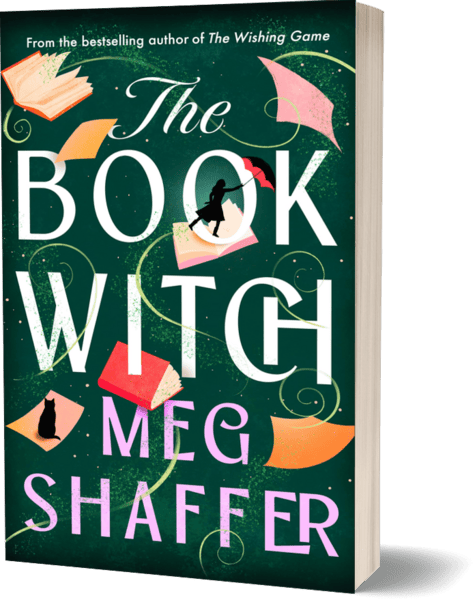
Jane: Welcome to the Jane Healey Happy Hour, formerly Historical Happy Hour, the podcast that explores new and exciting novels of all genres. I’m your host, bestselling author Jane Healey, and in today’s episode, we welcome USA Today bestselling author Meg Shaffer to discuss her latest novel, The Book Witch, which Kirkus Reviews calls, “Catnip for anyone that ever wanted to walk into their favorite book.”
Jane: Welcome, Meg. I’ll hold up this-
Meg: Thanks, Jane. Thanks for having me.
Jane: Thanks for doing this. I’m gonna do a quick bio about you, and then we’ll jump in. Meg Shaffer is the USA Today bestselling author of The Lost Story and The Wishing Game, which was a Book of the Month finalist for Book of the Year, a Reader’s Digest and Washington Post Best Book of the Year, and has been translated into 21 languages.
Jane: Meg holds an MFA in TV and screenwriting from Stevens College. She lives in Kentucky with her husband and two cats. The cats are not writers. Neither am I. Welcome again.
Meg: Thanks for having me. O-
Jane: yeah, thank you. Okay, so The Book Witch. You said that this is a love letter to books. What first sparked the premise of this b- story, which is about a coven of witches that literally steps into stories?
Meg: Well, come on, who hasn’t wanted to do that?
Jane: Absolutely.
Meg: What reader, what, what reader hasn’t wanted to, jump inside a book and hang out with characters? But, the idea came from actually a, a title I had that had been unused for years that I ended up not even using the title, but ended up being a title for a book within the story of The Book Witch, and kind of working my way backwards from that.
Meg: It was, it was an Alice in Wonderland-related title. I won’t give it away, ’cause it’s kind of a spoiler, but I knew I wanted to do something with Alice in Wonderland, and I also had read that, the original Nancy Drew books were about to go into the public domain, and, even though I wasn’t a big Nancy Drew fan as a kid, as I’ve gotten older, I really appreciate, her more as an adult, that in the 1930s there was this kind of smart-aleck, tough female detective, teenage detective, 16 years old, running around, driving on her own, being very independent in 1930.
Meg: You can’t help but kind of fall in love with, with Nancy Drew. So I knew I wanted to do something with Alice in Wonderland and Nancy Drew, and they’re both very, very different books. Mm-hmm. So how could I make that work? And when I came up with the idea of The Book Witches, these witches who can jump into works of fiction and interact with fictional characters, and also to, capture rogue fictional characters who’ve escaped their books and return them to their stories, then I found a way to incorporate all- all of the stories I loved, and wanted to talk about into one book
Jane: Such an interesting premise.
Jane: It’s like s- it’s just so much fun, especially for anyone who… I mean, and so many of the books that you mention in, in the story I loved. So, the main character is Rainie March, and her job is essentially to repair books from the inside out. How did you develop her as a character?
Meg: She was really fun to write.
Meg: She’s one of the very few characters I’ve ever written in the first person, and I think it’s just because we have so much in common, meaning we have no lives other than books. So, so, yeah, her, her job is just book. My job is just book. We had, we had a lot in common. But I, I am currently in Fort Meriwether, Oregon, where Rainie lives, which is actually Astoria, Oregon.
Meg: I changed the name for the, the book series within the book. And, Rainie is very much an Astorian. She dresses really practically. She’s alr- always ready for rain. She doesn’t dress up. She doesn’t wear a ton of makeup. There’s no reason to because it’s going to rain, it’s gonna ruin your hair and makeup, so just this sort of practical, down-to-earth girl, young woman who, is in love with books.
Meg: And she has a, a literal book boyfriend, her… the detective character she’s been in love with since she was a teenager, she’s actually gotten to meet in real life i- in the course of her work, and, has an actual book boyfriend. And I’m married to my book boyfriend, Andrew Shaffer, who’s also an author, which is the closest thing you can get to- Amazing
Meg: a book boyfriend, is a, a writer/artist husband. So yeah, we just had a lot in common, and I, I really infused her with my, my sense of humor and my, very practical, boring dress style.
Jane: That’s funny.
Meg: I’m currently wearing flannel and sweatpants, so
Jane: Rainie- Well, it, when in Oregon, right?
Meg: Yes. When in, when in, when in Rome, when in Oregon, yeah.
Jane: Yep, yep. So I was thinking about, like, I, you know, I write historical fiction. This is very much a fantasy story where you had to build the whole world, and the rules of the world, the book magic. There’s, there’s villains called the Burners. You had to make rules about what the witches can and cannot do.
Jane: Did you… L- like, how do, how do you do it? Like, do you map it all out? Like, when you’re building a world like this, do you feel your way along? How did, how did you do that?
Meg: You start kind of by feeling your way along. The most important thing for me is to just get started writing. A book this complicated is incredibly hard to outline.
Meg: It’s much easier once you’ve written a draft or two and have gotten to know the characters and the world a little bit. And then you start creating rules based on what the story needs. So, a story needs tension, okay? So where do you get tension? Well, if it, if there isn’t a rule about Rainie, or book witches getting romantically involved with fictional characters, then, you don’t have any tension in her relationship with the detective, the Duke of Chicago, but if- If I make it a rule that it’s against the rules-
Meg: For book witches to date fictional characters, now we’re in the realm of forbidden love, which is a great romance trope that creates a lot of tension in the story. So yeah, you, you start with the characters, you get to know them, and then create the rules as, as needed, to make the story work.
Jane: Very cool.
Meg: But lots of drafts … talk about- Lots and lots of drafts.
Jane: Yeah. Yeah, I, I would have to be. I was think- Yeah … ’cause like you, you, you’re not jumping off any research, you’re creating the research. You’re creating the- Yeah … base of it all, so yeah. I … So impressive. Talk about the Burners, which are like f- you gotta have a good g- good, good group of villains or a good villain- Yes, exactly
Jane: in the story. So, so talk about the villains.
Meg: Well, the villains are called the Burners, and they are evil book witches. They’re sort of book warlocks, and they have the same powers as the book witches, the ability to enter stories, but they do so with the intention of destroying stories, whereas the book witches are there to, defend and protect stories and restore them when they’re damaged.
Meg: And that just came out of reading the news, Mm-hmm … paying attention to what’s going on in the world, all the, the, this, everything old is new again, including book burning and book banning. So it, it’s, we seem to go through cycles of people try to do it, they, they fail ’cause libraries are immortal- Mm-hmm
Meg: and people will always love and defend books. And, and it’s not a good look to be, a book banner. That’s we- I think we all are sympathetic with the idea of kids reading appropriate literature for their age, you know. We’re not gonna give a Nora Roberts thriller to a, an eight-year-old, but –
Jane: Right.
Meg: Right, yeah … the, the idea of, just i- emptying libraries out simply because they mentioned, dogs having puppies or cats having kittens, and that’s, that’s suddenly sinful, Mm-hmm … it’s maddening. So- Totally … so we’re going through that again. We’re having another cycle of, of book banning. And it was very much on my mind.
Meg: And, you know, again, as a story need is stakes, what’s at stake? So, are these book witches… In the beginning it was just, oh, this character can do this fun thing. Then you have to ask why. What is she doing it for? And people like a, a main character with an ethos, with, something they believe in, something they’re willing to die for to defend and protect.
Meg: So Rainey’s not just powerful, but she’s a good, moral person who, is willing to risk her life for something she believes in, and that is, to defend stories. ‘Cause she, she knows how important they are to her. Mm-hmm … you know, she’s been through a lot of grief and loss in her life, and stories were her comfort, so she knows how important they are.
Jane: I have another question about that in a minute. I wanna talk about the choices you made in terms of the stories she goes into. Love Jane Austen. I’m a huge Jane Austen fan. Who isn’t?
Meg: Yeah … Pride,
Jane: Pride and Prejudice in particular, but all of them. Als- Alice in Wonderland, Arthurian legend, Great Gatsby.
Jane: Like, how did you decide which literary worlds to include, and were there any that y- that left on the cutting room floor?
Meg: Oh, yes. So, part of it was, you know, what- What can I do safely that is in the public domain? So that was a number one decision. If I’m going to be quoting huge passages or using others people’s work, I, I don’t like stealing from other people unless I’m allowed Mm-hmm.
Jane: Mm-hmm.
Meg: I mean, I will, I will borrow, but I will pay, pay, let’s call it paying homage. So I wanted to make sure that the works I was paying homage to were in the public domain, and also ones that meant something to me. Not necessarily my favorite. I, I don’t go back and reread The Great Gatsby all the time.
Meg: My husband does, but I’ve read it probably three times in my life, and I might read it again someday, but, it’s a book that, speaks to me, and I think it speaks thematically to, the characters in the book. You know, when Rainey is talking to Duke about the character of Gatsby, how, he was, trying to write his own story.
Meg: And Duke is a character who wants to write his own story. He doesn’t wanna be stuck in the role he was born into or written into. So in that way thematically that, that story worked, but it also just worked well in the plot. It’s one everybody’s familiar with, and who- Mm-hmm … doesn’t love a Gatsby party?
Meg: So why not send the characters to a Gatsby party? Absolutely. Yes. Yeah, yep … so it just, it just worked so well in the story. Things that were left on the cutting room floor, my favorite fictional character, my book boyfriend, is The Count of Monte Cristo, of, written by Alexandre Dumas, the French writer who also wrote The Three Musketeers.
Meg: So I love him too much- … and as my husband pointed out, my husband who’s, who’s my other editor other than my editor at Random House, pointed out that The Count of Monte Cristo is so sexy that the minute you put him in a scene with Rainey, you want Rainey and the count to be a romantic couple- … and she already has a boyfriend, so it just didn’t work.
Meg: Right. So I had written this great scene, where, The Count of Monte Cristo comes and tells her, you know, kind of informs, he’s heard rumors, he’s, he knows every- he’s a very smart guy so he’s figured things out, but it, it ended up not really working. And what w- I replaced that with, my agent had suggested Lizzie Bennet from Pride and Prejudice, which I was resistant to ’cause I love the count so much and I felt like, you know, Pride and Prejudice had been a little overdone, until I wrote it, and then it became so meaningful to me as a writer, this moment that Lizzie has with Rainey- Where this probably one of the smartest female characters in literature, just really astute- Mm-hmm
Meg: really wise, understands human nature and psychology so well. She has her blind spots, of course, her prejudice, but, to have a character like that who you knew if she were alive today she would be a, probably a PhD, she would get to go to college. Sh- her whole life wouldn’t be about getting married.
Meg: Mm-hmm … she would probably get married, and you’d want her to have a happy relationship, but, th- that moment on the beach where she talks about, “Oh, I met a girl who went to college,” oh, it just broke my heart writing it.
Jane: Yeah, yeah. So it
Meg: became- So great … really meaningful, so I’m really glad they pushed me on that and I made some changes to the story, ’cause, yeah, it was, it was nice to have Lizzie in there after I wrote it.
Jane: Yeah, I, I, I probably wa- I probably read it every couple of years, Pride and Prejudice, and watch the movie, like, whenever it’s on TV, basically. Yes. So I liked seeing that in there. I wa- I was reading your, author’s notes too. I wanna talk about … I w- I was actually a huge Nancy Drew fan growing up. And you talked about how you researched into the real author behind the pen name, and-
Meg: Yes
Jane: you learned a lot about h- the whole catalog. Talk a little bit about that. I thought that was so interesting.
Meg: Yeah, so it’s a really weird story. People remember Nancy Drew and the Hardy Boys, but that’s, that’s kind of, historical bias. We’ve heard of them, so we thought those were the only ones. There were dozens, maybe hundreds of young adult, and tween-age book series in the late, 19th and early 20th century.
Meg: There was, like, a 50-year span of just, girl detectives, boy detectives, stuff like the Bobbsey Twins, all these books. There’s just this huge- And Felicia Brown, do
Jane: you remem- do you remember that one? That was a big one.
Meg: When did those come out? I thought those were more, like, the ’40s and ’50s, but this was like-
Jane: Those
Jane: Yeah, those were a little bit later on. The-
Meg: Yeah, yeah … yeah, like, like, the teens and ’20s and ’30s. And a lot of them- Fascinating … came from, one man who started this sort of syndicate, this corporation that, the, the man, I forgot his name, it’s been so long since I’ve read the, the research, he would come up with the ideas, and then he would hire writers to write them out.
Meg: And he came up with Nancy Drew, and, ha- passed it on to one of his staff writers, a woman named Millie Benson, and, she wrote, I believe, the first 30 books from- Wow … the 1930s. And they’re about twice as long as the ones most people are familiar with. If you go to a bookstore now and buy this Nancy Drew: The Secret of the Old Clock, it’s, it’s a shiny yellow book, yellow spine, it’s not very long.
Meg: But the original 1930s one is about twice, twice the length. Nancy is blonde instead of a redhead, and she’s 16 instead of 18, and she’s a bit more of a troublemaker instead of a rule follower than she is in the, in the yellow spine books. So they were, they were rewritten and kind of, shortened and rewritten in the 1950s and ’60s.
Meg: But yeah, Millie Benson was, was a really interesting woman, incredibly smart, well-educated. If I remember, she, was, like, a, a trick diver, and I think she, she tried to … She learned how to fly a plane early on. I mean, she was just a real character. But her name was suppressed for years, because it was- Wow
Meg: hidden under the, the pen name of Carolyn Keene. And there was a lot of controversy whether the, … who was the original writer of the first 30 books. And one, one woman claimed it was her, and, other people claimed it was them. So, finally research has come out that it was probably Millie Benson who did the first 30.
Jane: Wow, I never knew that, and I, I knew the later versions obviously. So yeah, that’s so interesting. I didn’t know that at all.
Meg: Yeah, the original- Another thing- … 1930s versions- Go ahead … you know, they’re a little, they’re a little dated, but, more so than the 1950s ones. But they’re kind of more interesting too.
Meg: So I really recommend at least going back and reading one or two of the original, the, the thicker ones.
Jane: Yeah. That’s so cool. I imagine they must be worth, quite a bit now too, those, those, like, original, original versions. Oh, I’m
Meg: sure. Yeah. Yeah. I only had a reprint, but yeah, they’re still out there.
Jane: I’m sure. Another thing I read is about you, is that, A Wrinkle in Time is the novel that made you want to be a writer, and that is, like, a such an important book in my life. Like, I think- Oh, yes … when you read a certain book at certain age, that’s, that’s probably one of the ones that made me wanna be a writer, and I always- Mm-hmm
Jane: joke, like, my younger daughter’s name is Madeleine, spelled the same way, and I feel like I subconsciously named her after Madeleine L’Engle. Why, why do you, why do you cherish that story, and why do you think it resonates so much with so many… I mean, so many authors I talk to adore that book
Meg: Well, it’s, it meant so much to me that I picked Meg as my pen name.
Meg: So For, for Meg Murry. When I read it, it was a fifth grade assigned reading, and it was science fiction. And we had been reading other great books in, the fourth grade and the fifth grade, but I remember reading stuff like The Pushcart War and The Lottery Rose and Where the Red Fern Grows, which were very down-to-earth, realistic- Mm-hmm
Meg: They were kids books, but they were, they were very much set in the real world. And the first time, if you’re, if you’re someone who loves sci-fi, your first sci-fi book where you have a kid in space, it will just blow the top of your head off. I, I- Mm-hmm … I had wanted to go to space camp, join NASA.
Meg: I already loved Star Trek. So it was, it was wonderful to read a girl my age who was smart, not very attractive, and misunderstood with a bad attitude, and I thought, “I love this kid. I love Meg.” Mm-hmm. She is me, I am she.
Jane: Yeah.
Meg: Which, which is interesting, ’cause she’s really, really good at math and terrible at English and history.
Meg: So the stuff that I was good at, she was bad at, and vice versa, but it was just, kind of her attitude toward life, and, and her intelligence and her drive, and that, that she was a bad girl. She got in fights and she was angry and, she was still the hero, though, Mm-hmm … and had this incredible heart.
Meg: So yeah, I, just reading that book, it wasn’t so much I wanted to be Meg after reading it as I wanted to write things like that.
Jane: Mm-hmm. Yeah. I c- I completely agree. I still remember reading it and, and wanting to be her or, like, relating to her so much in a way that, like, I, I didn’t, that didn’t hit me with many books at the time, and I just- Yeah
Jane: yeah, I loved it so, so much. If you could step inside one book the way Rainey does, which book would you choose?
Meg: That is a, a tough one. It’s probably one that changes every day, ’cause one day it will be A Wrinkle In Time, and, but then again, that’s, that’s the story for the kids, and I, I’m a little too old for that now.
Meg: I want them to have their adventure. I don’t wanna steal any thunder from them, but- … yeah, I would absolutely love to meet The Count of Monte Cristo. However- … he is so handsome, I don’t know if I’d come back, so my husband might frown on that.
Jane: Oh, that’s funny.
Meg: But yeah, I w- there are so many. As I get older, it changes.
Meg: You know, I would love to step into John Williams’ Stoner and meet Professor Stoner. I, that book meant so much to me and my husband. We, we read it at about the same time, and both just sobbed over it, and just, it just gutted us. The character has such incredible integrity. You know, he doesn’t do anything particularly extraordinary other than live a life of integrity, but these days that seems even more extraordinary.
Meg: Mm. So yeah, different book every day, but, yeah, absolutely A Wrinkle In Time would be one of them. Or, you know, I, I’m no snob, and, I’m a Trekkie. R- one of Diane Duane’s Star Trek novels would be great. Oh, sure. She wrote the best Star Trek novels. Go and meet Captain Kirk and Mr. Spock finally.
Meg: That would be amazing.
Jane: Absolutely. Ha- so I was think- when I was, you know, preparing for this I was thinking like, “Oh, this would be a super fun, like-” TV series or movie or something, and, has there been any interest, and who do- who would you like to play Rainey and The Duke in the movie version?
Meg: You know, I haven’t thought about it.
Meg: I mean, yeah, I, I do have a Hollywood agent whose job it is to try to, try to sell it, and, you know, I’ve gotten a couple emails of somebody’s reading it, this person, this actress is reading it, this director’s interested. But does anything ever come from that? Mm, not really.
Jane: Yeah.
Meg: Hope- hope springs eternal.
Meg: But when I picture Rainey in my head, she’s just Rainey, and, and The Duke, they’re, they’re their own thing, so I never really think about casting them. But there’s, there’s so many great young actors and actresses out there. But yeah- There are … when I, when I tend to picture people, they, they’re long dead, you know?
Meg: So for example- … the joke in the book is that, Duke looks like Gary Cooper, a young Gary Cooper, and the, the line is, “Google young Gary Cooper. Nothing bad will happen.” And I had someone on Instagram t- message me and say, “I did Google young Gary Cooper, and you’re right, nothing bad happened.” He was extremely handsome.
Meg: He was apparently quite awkward looking in real life, but as soon as he was on film he, he just was so unbelievably angular and photogenic that he just transformed on film. Mm-hmm. So yeah, it’s worth looking up his pictures. But, you know, Rainey, Rainey’s a little bit of a fast talker. One of the, the classic actresses from the 1940s, Rosalind Russell or somebody who could, who could spit out really good banter, fast dialogue- Mm-hmm.
Meg: Mm-hmm … would be great, but yeah. Whatever you imagine is okay by me.
Jane: Awesome. I w- I have a few questions about the w- about writing in general that I ask everyone who comes on. You talked a little bit about your process. I… one question I always ask is are you a plotter or a pantser? Like do you plot things out or do you write by the seat of your pants?
Jane: It sounds like yours is kind of a little bit of both, would you say, or-
Meg: Well, I was on a panel with a romance writer once who when asked if she was a plotter or a panster, she accidentally combined them and said she’s a prankster. And once she said that, I was like, “That is genius. I know you didn’t mean to say that, but that is genius.”
Meg: And I realized that’s what I am. I’m very oriented toward the end of the book and the twist, some kind of twist I can pull on readers to surprise them- Mm-hmm … that they don’t see coming. And the book which has about six of them, there- Yeah, very twisty plot … there’s about, yes, five or, five or six twists. So even if you guess three of them, there’s still three that you haven’t guessed.
Meg: So that’s, that’s what I feel like. I, I, I do plot and I do pants, you know, just write from the seat of my pants, but it’s always because, you gotta do a little bit of both and be open to the possibilities if you’re really gonna surprise your reader ’cause you have to be willing to surprise yourself, which you can’t do just plotting.
Meg: But if you come up with a good twist, you really do have to outline, to make sure it’s set up perfectly to really, really surprise people, but also if they reread, to see the, the hints that they missed, Mm-hmm, mm-hmm … which is how you play a good, literary prank on a reader, to set them up to think one thing and then, then show them something completely different.
Jane: I completely agree, and it’s funny, I, I was like, my first book I really plotted it out, and like this latest one I’m like, I’m trying to like give myself room to like, like you said, to make discoveries on the way. Mm-hmm. ‘Cause if you’re not… If you’re so rigid about it, then like some of the fun parts of writing where you’re like, “Oh, that would work,” you know?
Jane: I, I… Like, that creative process, I feel like it s- gets a little stifled if you’re like too rigid. Yeah,
Meg: and the characters really do, really will take on… You know, they have a mind of their own sometimes, and- Mm-hmm … you’ll just be writing and the, a character will say something that would ch- completely change the way you look at them and will open up the possibilities for the story, so you do have to be open to it.
Meg: So I will tend to just write the first couple of drafts just write, and then once I have a good handle on the characters, then I can outline and really start, you know, focusing on, on the heart of the story and deleting things and just getting, getting it down, just right. Interesting. Getting all the dominoes lined up so, you know, you can knock ’em over and they go down in a straight line.
Jane: Right, right. What do you find the most challenging part about the writing process, and what is the part that you enjoy the most?
Meg: Sorry, I’m by a window.
Jane: Oh, that’s okay.
Meg: The, a motorcycle just went by.
Jane: Oh, I was like, I thought that was on my end. I’m sorry.
Meg: No, no. The most challenging part, gosh, it’s all hard.
Meg: So I, I… the way I have described it is if you remember the old circus act of spinning plates, the plate spinner who has tried to get all 30 or 40 plates spinning at once, and while they’re spinning one plate, another crashes down. So something like The Book Witch is extraordinarily complicated. It- Mm-hmm
Meg: is, is a book within a book, fictional characters, real characters, other fictional characters, multiple storylines, and it has to be simple. It has to be s- you have to take something extraordinarily complicated, like a book like The Book Witch, a plot like The Book Witch, and make it read so simply that a reader doesn’t even notice how complicated it is.
Meg: They don’t have to flip back a few pages and go, “Wait, what is happening?” Mm-hmm … they’re not never confused. They… it feels like they never hit a speed bump. It’s just straight A to Z to the end, without ever noticing the man behind the curtain.
Jane: Mm-hmm. I think about that all the time.
Meg: Yeah. Never seeing the strings and never letting any of the plates crash.
Meg: Mm-hmm … so yeah, that’s, that’s the complicated aspect of it. That’s the hardest part is making it look easy.
Jane: Totally agree. Completely agree. You have an MFA in TV and screenwriting. Has, has that shaped the way that you write novels in any way in terms of-
Meg: Yeah …
Jane: scene construction or dialogue or any of it?
Meg: Absolutely because I used to be a romance novelist and wrote, like, you know, 30 romance novels for Harlequin or something back in my old life. Mm-hmm … and they were, they were very heavy on dialogue and banter, which is great, and people love that in romance novels. But after my MFA in screenwriting, I learned to be a more visual writer, and I also learned to cut.
Meg: You have to understand in a, in a major motion picture- You, you can budget bare minimum $1 million per page of script. So if, if it’s going to be a major motion picture, a major movie from a major studio with major stars, an 80-page script could mean an $80 million budget. So you learn to write tighter. But you also learn to write very visually, so you tend to set, I s- I started to learn how to set scenes in more interesting places, and to block scenes, have characters doing more interesting things than just sitting and talking to each other or laying in bed- Mm-hmm … and talking to each other. So you try to have, more interesting settings as well, something that people can visualize really well.
Meg: So I think, I really think the MFA in screenwriting helped me improve my writing. So I write shorter, tighter, and more visually.
Jane: Mm-hmm. Oh, so interesting. And you’re a writing instructor as well, so I always ask this two-part question. What’s the best advice you can give about writing, and what’s the best advice you can give about getting published?
Meg: They’re kind of the same. I, when I was in college, I was stuck on, with the chair of the English department at a seminar for four hours. It was like a, a freshman welcome event, and I was the, the student representative of the English department, and the chair of the English department, Dr. Lucas, was the, the faculty representative, and it was gonna be four hours long, and I was stuck at this table with him for four hours with this, this very handsome, intelligent college professor, and I had to make conversation.
Meg: So I started gossiping, of course, and I said, “You know, Dr. Lucas, based on the, the students that are currently in the English department, who do you think has the best shot of making it as a real published writer?” ‘Cause we all wanted to be writers. And he mentioned a student’s name, and he said, “I think it’s going to be this guy has the best shot because he deletes a lot and he throws a lot away.
Meg: He is, he is really, he takes his writing really seriously. He’s not, he’s never satisfied with his first draft. He cuts, he deletes, he throws away, he rewrites.” I had never heard that before. It, it never occurred to me, you know, I would write a poem, and it would be done, and I would, like, hang it on the fridge like a proud mom.
Meg: “Look what I did.” “I wrote a poem and you didn’t.” I didn’t realize that, like, oh, no, that’s just the beginning. Mm. There’s so much left to do. I have to actually make it good now, and that can- Yes … often include, deleting the whole thing or just saying, “You know, this isn’t good enough. It’s, it’s not good enough to show anybody.
Meg: I gotta rewrite it or throw it away or write something different.” And that, from that day on, I learned to delete, and I learned to rewrite. Mm-hmm. And I’ve done it ever since. So maybe 500,000 words of writing the book, which to get it to 83,000 published words, easily 500,000. Wow. Yeah.
Jane: Wow.
Meg: That was an unusually difficult and complicated book.
Meg: It’s not- Mm-hmm … always that much, but sometimes it is. The Wishing Game- Yeah, yeah … was not nearly that complicated. The Lost Story was. The Lost Story probably almost went to nine or 10 drafts. It just did not wanna break open and tell me its secrets, but yeah. And that’s the thing with publishing too.
Meg: It’s not just writing, it’s publishing. Your, your agent will give you, suggestions, and you probably should take them, and that means deleting- Mm-hmm … and rewriting. And then your editor will definitely give you suggestions, and sometimes dictates, and you better be willing to delete and rewrite. If you are so married to your vision that you will not listen to anyone else’s advice, just go self-publish.
Meg: Mm-hmm, mm-hmm. Do not try to get into traditional publishing. That’s, this is collaborative. Ultimately, your vision is the most important one, but you do need to be willing to listen to other people, ’cause they’re probably right.
Jane: Yes. I, that’s such, such good advice. I know. I, I’ve had the same editor for all of my books, and she
Jane: I, I … Someone was like, “Well, don’t you push back? Don’t you say no, and I … You know, I don’t wanna change this or that?” I’m like, “No,” ’cause she, she’s, like, rarely wrong. Maybe-
Meg: Yeah …
Jane: 1% of the time I push back, but the rest of the time, like, she, her instincts are, are perfect. So yeah. Yes. That’s what they’re there for.
Jane: That’s why they get paid what they do, you know? So yeah.
Meg: Exactly.
Jane: Yeah. Are you ready to share what you’re working on next?
Meg: Oh, absolutely, yeah. So I just turned in my next book to my editor, two Fridays ago. I think it was May 29th, so not that long ago, and it’s a Christmas book. So it’s … I was thinking, “You know, what, what, what’s another story that I loved that means a lot to me that I wanted to play with?”
Meg: And the one that jumped to mind was, Christmas Carol by Charles Dickens. Nice … but this particular one is more from a ghost’s point of view, than Scrooge’s point of view. So, we have a, a very, very friendly, sweet ghost who is hoping to get the job of the Ghost of Christmas Future. The Ghost of Christmas Future’s retiring, and she wants to help people.
Meg: And who doesn’t wanna be a Christmas ghost? They’re the rock stars of the ghost kingdom. But since she’s so nice and so sweet, she’s terrible at scaring people and, and the Ghost- … of Christmas Future is very scary. So she decides to haunt a living horror writer in the hopes he will teach her how to be scary.
Meg: So that is- I love
Jane: it.
Meg: Yeah.
Jane: That’s great.
Meg: So it’s kind of a fun buddy comedy. Yeah, yeah … it’s a real, real two-hander. This, this ghost who, is full of life, and this grumpy, horror writer who’s a little bit dead inside. And, through their friendship, they both change each other for the better
Jane: Very cool.
Jane: A- and that, is that for this Christmas or next Christmas?
Meg: Next Christmas.
Jane: Yeah, yeah. Con- that’s amazing. You’ve been busy. Geez. Yes. Impressive.
Meg: Oh, yeah. I’ve already started another book, of course.
Jane: Oh, my goodness.
Meg: What am I gonna do?
Jane: Right, right.
Meg: Nap all day like a cat? Oh, if only.
Jane: If only. What is the best way for readers to keep in touch with you?
Meg: Well, I, I check Instagram a couple times a week, and that’s Instagram, meg_shaffer. Otherwise, yeah, see me at a, at a book event. We’re going to be planning some. C- so g- go to megshaffer.com and click on events and, we’re going to be adding quite a few this year, hopefully around the Pacific Northwest where I’m hanging out.
Jane: Excellent, excellent. This was lovely. Thank you so much for doing this. I’m glad we finally got to, got to get together- Yeah … and schedule our pod.
Meg: Thank you, Jane. This was great.